

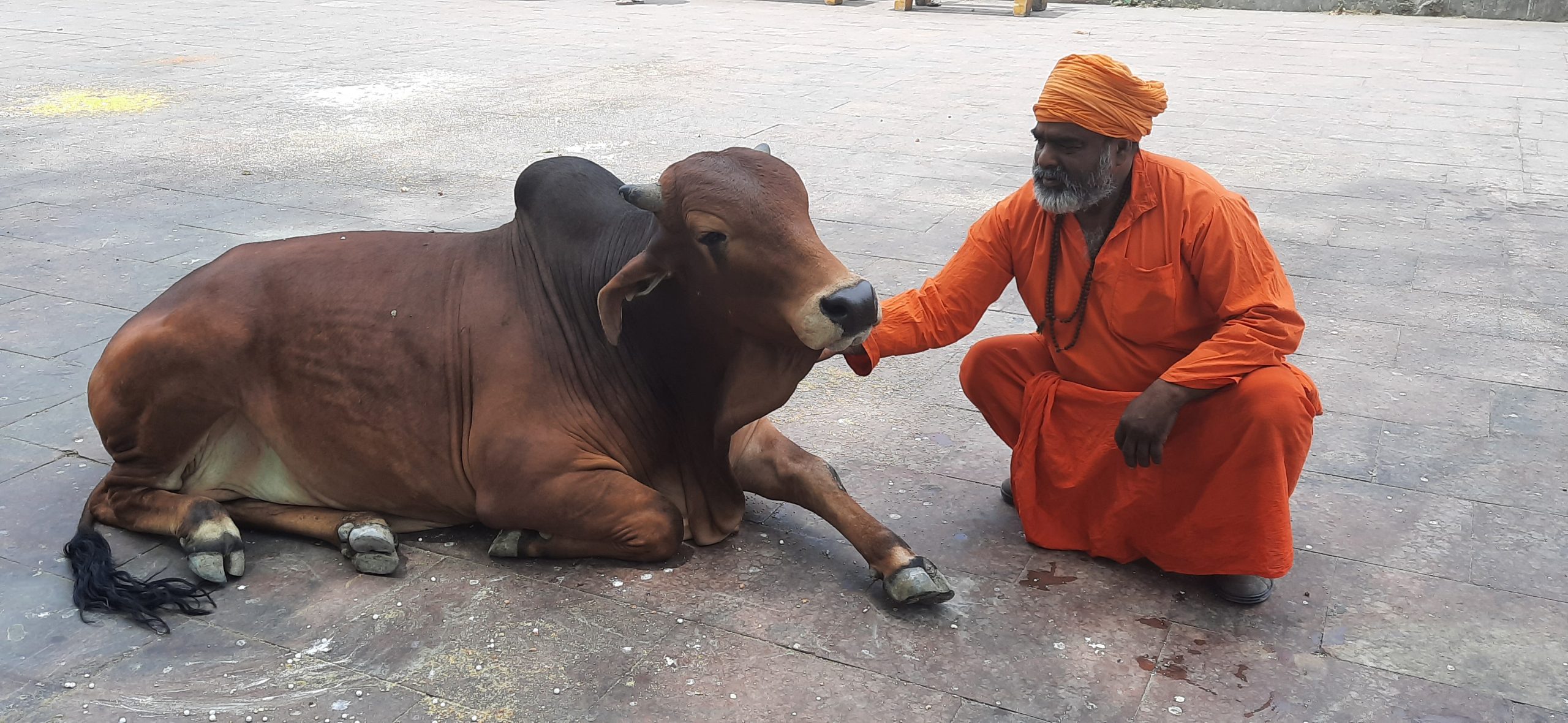
In Ayurveda, health is defined as “well-being within oneself.” This inner well-being can be nurtured, and one can become more sensitive to it.
Suman, the wife of my landlord’s caretaker, began massaging her baby twice a day for about 20 minutes already two weeks after giving birth – vigorously, as if she were working with chapati dough. “When babies are massaged, they feel good inside later on,” she explained. Apparently, she knows “well-being within oneself” from her own experience.
I wasn’t massaged as a baby and only discovered in India what it means to feel good inside, or even to be able to feel ‘inside’ at all. Yoga, pranayama, and meditation helped me. These are methods practiced in India for millennia, making people receptive to simply FEELING their inner selves without thoughts commenting on these feelings. These methods direct attention inward, where more blissful tranquility is present than we realize. Simply being aware how it feels inside, and even if you don’t feel anything, staying with it for a while, helps to direct attention in the right direction – towards our essence.
A vibrant stillness, pulsating with intense joy, is what remains when the ego stops making noise with negative thoughts and feelings. It is the invisible foundation of everything, the subtle essence in everything, hidden deep within every person, regardless of their external circumstances. And this essence is accessible precisely because it is contained within each human being, much like the ocean is contained within every wave, or rather, every wave is made entirely of ocean.
Theoretically, accessing this essence sounds easy: Attention must shift away from objects (one’s own person and thoughts are also objects in this sense) and toward attention itself. In other words, consciousness, which normally is aware of objects in this universe, must become aware of itself, or rather, recognize itself.
In practice, it’s not so easy, because it requires at least some moments of stopping thoughts, going deeper, and feeling this wonder of one’s own existence within. Perhaps consciously folding one’s hands in gratitude and noticing the goosebumps, and not brushing them off as insignificant and moving on in our daily routine. Access to one’s own essence is possible at any moment. Inner stillness and joy are, so to speak, waiting to be discovered. They are always ready, always present, and they may wonder why people seem to prefer inner noise and restlessness to this stillness and joy.
The mind pulls outward but it’s worthwhile to resist this pull
Yet strangely, it appears to be more satisfying to read the newspaper, or watch TV (nowadays it is looking at the mobile), or make a cup of coffee than to quietly turn inward.
For many years in India, I had no home and therefore had no newspaper, no telephone, no television, and no kitchen, and therefore plenty of time for meditation. I regularly sat for an hour each morning and evening, and earnestly asked for help to recognize my true self. Yet, I cannot say that I clearly felt my essence. It seemed more as if I were merely looking at the veils that conceal it.
Once, I even stayed for three days in a room furnished with only a bed, table, and chair, resolving not to write, not to read, and not even to go out onto the veranda. The housekeeper cooked for me, so I had nothing to do – I either sat on the floor trying to meditate, did yoga, or lay on the bed. Enlightenment didn’t come, but in the days following my retreat, an article poured out of me, which a psychology professor in Germany happened to read. He felt, I would be the right person to contribute a chapter on the Bhagavad Gita to a reader for psychology students. And a few years later I came to know that a philosophy professor of my own Alma Mater, Hamburg University, recommended to his students my articles to learn about Indian philosophy. Thus, my retreat led to a greater engagement with the world. It was personal evidence that meditation is not escapism.
Moderation and a pure aspiration are needed
However, some Westerners overdo it and can be very rigid when it comes to their spiritual practice. In the 1980s, I met Gopi Krishna in Dehradun, who had written several books on Kundalini energy. He knew that it is dangerous to overdo meditation – in a manner of “come hell or high water”. He had done just that himself and had subsequently suffered under mental problems for 12 years.
Kundalini is a powerful force, not to be trifled with. Because of his books, he attracted Westerners who had also meditated too rigidly, and I met several of them. Most had problems, and Gopi Krishna’s main advice was to lead a moderate life.
“We Indians don’t need to meditate. Only you foreigners do,” a friend once remarked with a smile. He had picked up a Frenchman in the city who was wandering aimlessly through the streets of Dehradun after a 10-day Vipassana meditation retreat. My friend offered him a place to stay for a few days and was then stunned at how inflexibly the man adhered to his meditation schedule. Indians are generally adaptable: his family only ate their meals when it suited their guest (in my view, they shouldn‘t have waited).
Small, but helpful reminders
Life in India these days is hectic, and few Indians take the time for meditation. They leave it to the hundreds of thousands of sadhus, or ashramites who have dedicated themselves, so to speak, to the professional and full-time search for truth.
Nevertheless, many begin their day with a small puja at home. In the morning, before the first passenger boards the auto-rickshaw, taxi, or bus, many drivers hang a small garland of flowers in their vehicle, fold their hands, and close their eyes for a moment. They surely do it with genuine fervour, for they truly risk their lives anew each day and need divine protection.
Many shop and restaurant owners also light an incense stick and pass it before a small shrine in a corner of their shop before attending to their first customer. They may be asking for good business, but it is a prayer nonetheless. There are also countless moments throughout the day when many pause and remember the divine. Every time I pass a small temple in one of the three-wheeled share taxis, several of the passengers look in its direction, lower their heads, and respectfully touch their eyes. Even ‘modern’ young men in jeans and with fancy hairstyles do it.
In the evenings, many light an oil lamp in the prayer room or in front of the house before switching on the lights. And at sunrise, many spontaneously fold their hands, and I get goosebumps.
Incidentally, according to the Vijnanabhairava, a text of Kashmir Shaivism, goosebumps are very valuable. It’s a moment when thoughts stop, and therefore an insight into one’s own being is possible if one consciously “catches” this moment.
I am often amazed by the many small “reminders” that basically everything in this world is a miracle. According to the Indian calendar, we are currently living in the Kali Yuga, the darkest of all ages, where the world has become materially dense and separated itself from the divine. But in India, this separation doesn’t seem to be quite as complete as elsewhere. People are aware that Ishwara or Bhagawan (they have many names for what in English is called God) is present in this world and in themselves. They see the divine in earth, water, fire, air and in living beings – an attitude that we in the West are slowly learning to appreciate, although for centuries we devalued such views as a “primitive nature religion”.
One consequence of this Indian perspective is feeling protected within the Divine, rather than being a lone fighter in the world, or rather ‘against’ the world. This is probably a reason why Indians are generally calmer. They have a powerful ally right within themselves, always present, in whom they can fully trust. This brings a certain lightness to life. And when one manages to fully surrender to this inner Presence, it occasionally draws one into the still eye of the world’s storm, where it is at home and where absolutely nothing can harm one. And who knows, perhaps it will let one be at home there – in a loving embrace.
For this is possible, the Indian rishis claim, supposedly from direct experience.
(The above article is part 2 of a chapter for the German anthology “Wege der Stille”.)
Link to the first part: https://mariawirth.com/inner-stillness-in-outer-noise/
if you like my writing, consider getting my books
Title: “Why Hindu Dharma is under attack by Muslims, Christians and the Left” 2025, Rs 311
link: https://www.amazon.in/dp/8119670655 or
Why Hindu Dharma is Under Attack by Muslims, Christians and the Left: A Collection of Essays
Title: “Thank you India,a German woman’s journey to the wisdom of yoga” 2018, Rs 349
link https://garudalife.in/thank-you-india-by-maria-wirth
they are also available as Kindle
