

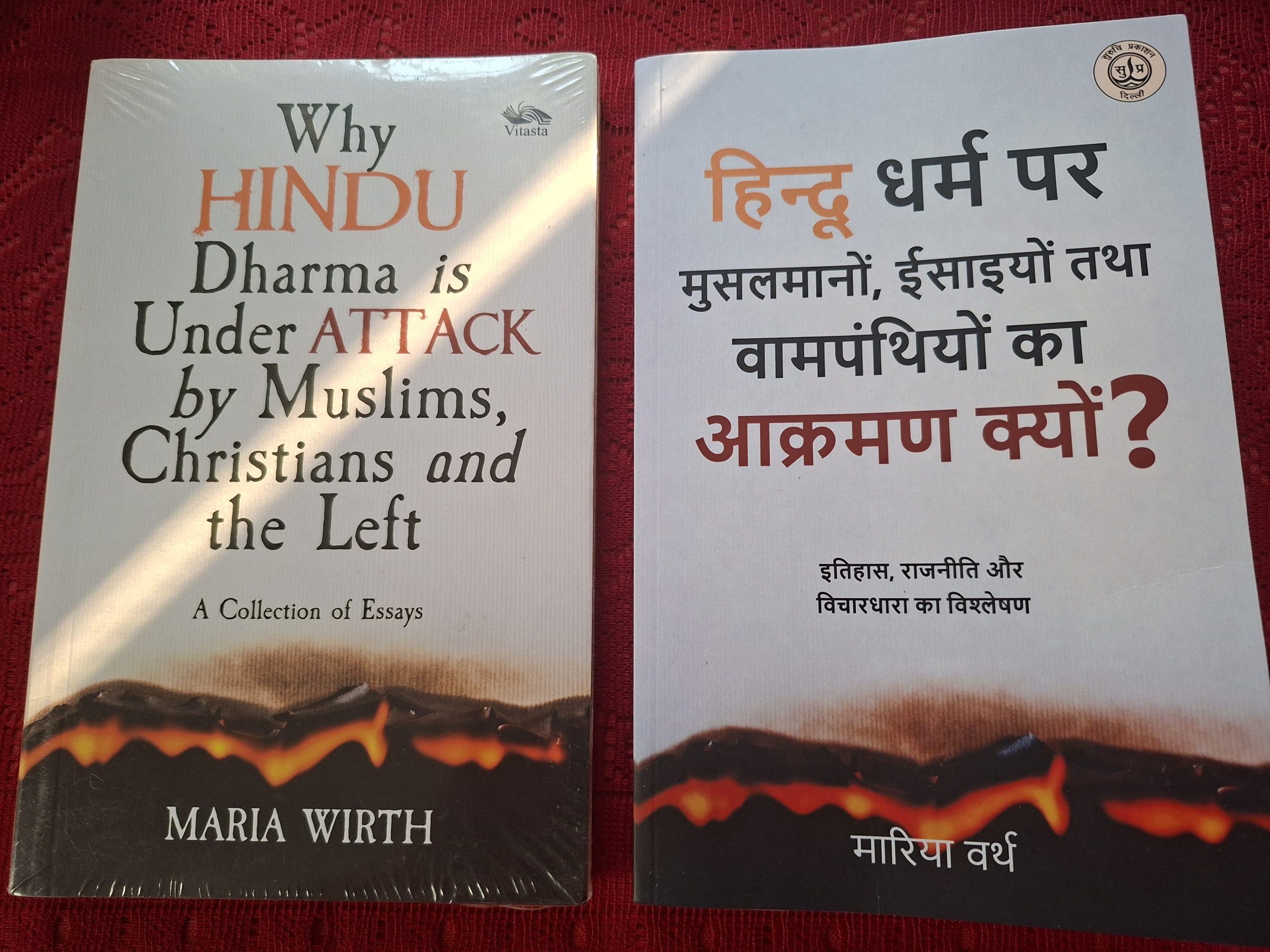
My book “Why Hindu Dharma is under attack by Muslims, Christians and the Left” has now also been published in Hindi by Suruchi Prakashan. Please share this with your friends who prefer to read Hindi. I paste here the introduction, to give you an idea about the book:
The world has changed significantly within the last few years. Many of these changes are very concerning, especially the casual talk by some politicians about the possibility of a nuclear war, and the dangers of artificial intelligence, which will not only render many jobless and possibly directly influence our thoughts, but may even go out of human control. Further, the big economic downturn in many countries and the increasing censorship of speech. It seems as if the world is moving towards a China-type controlled one-world society.
In this scenario, social media is both a boon and a bane. It is a bane, when it keeps our attention, addictively, on scrolling for ever more information or entertainment, without giving us a break to be present in the here and now—the most important place and time of our life. And our phones may even lure us into debasing our life with violent computer games or pornography.
Yet, on the other hand, social media has also contributed greatly to waking people up to what is happening. ‘Deep State’ has become a household word. Mainstream media has lost the trust of many. Even science, academia, and medicine have come under scrutiny and do not look so good and innocent any longer. Too many claims, ridiculed by the media as ‘conspiracy theories’, have unfortunately been confirmed as true.
There is another, very positive aspect which gets traction, and that too, is thanks to social media platforms—more and more people are searching for the Truth—not merely questioning facts that are presented by the media, but searching for the big, transcendental Truth about God and themselves.
Many Westerners are going back to Christianity and declaring their faith in Jesus. Even a decade ago, it would have been inconceivable that Tucker Carlson, a big American influencer, would ask Russell Brand, a big British influencer, on stage to lead an audience of ten thousand in prayers.
I consider it a good development for Westerners. The erosion of belief in a Supreme Power was obviously planned—starting in Russia and China with communism and taking root in the West with the Hippie movement of the 1960s.
Now, there is a pushback against the agenda which wants us to identify only with the body, and focus only on sensual enjoyment, never mind how low that enjoyment may be. The Zeitgeist is changing, even though the elite still try to convince us that ‘It is ridiculous to believe in a God or a soul’ (a recent quote by the celebrated historian and author, Yuval Noah Harari who is a regular at the World Economic Forum).
Yet, I wish that people all over the world would know about Bharat’s Eternal Wisdom, called Sanatana Dharma. Or rather, I wish they would know what this Eternal Wisdom is really about and not be influenced by false, mischievous claims by those who don’t want this Wisdom to be known.
The reason: Sanatana Dharma is closer to the Truth than Abrahamic religions.
Devotion to God or Jesus or Allah is definitely helpful in life. But doubts may arise from time to time, because those religions are all about ‘belief in a story’ that happened several hundred years ago. It is all about ‘thinking’ and not about ‘who or what enables thinking’.
Since ancient times, India was the ‘Land of Wisdom’. Vedic wisdom is not based on belief in a story. It gives knowledge about the Absolute Truth and asks us to verify it by experiencing it within ourselves—true Self-Realisation.
The most important knowledge is: We are not small persons in a big world, but are one with Brahman. And Brahman, though indescribable, is best described as limitless, blissful Consciousness, out of which, this world and everything in it, ‘appears’. It means, the world and our small, individual selves are not solid. They are more like Virtual Reality, or in Indian terminology, Maya. What is ‘solid’ and really true is only our essence or self—Pure Consciousness.
When I heard this for the first time back in April 1980, at the Kumbh Mela in Haridwar—it immediately made sense to me. For the first time, I got convincing answers to questions that had troubled me since my teens.
Questions like:
– What is most important in life?
– Is there a God?
– Is death the end of me?
These questions were now replaced with the most important question:
– Who am I really?
Yet, this question cannot be answered with words. It needs to be ‘known’ within. The goal of our life is to realise the truth of who we are.
I wanted to dedicate my life to search for the Truth and stay on in India, because the country was just more conducive for spiritual search. Yet to do this, I needed a longer visa and earn some money.
So, in 1981, I wrote my first article—about insights I had gained while being in the presence of Sri Anandamayi Ma and other great spiritual personalities like Devaraha Baba, and from reading numerous books and sitting still for many hours in meditation. I felt that this precious wisdom, which is still alive in India, is lacking in the West.
I was fortunate. This first article was published in the German magazine Psychologie Heute; two other magazines reprinted it. The editor asked me to continue writing, as he had rarely seen such clarity regarding Indian Wisdom. He even gave me an advance for my next article—a report on a conference in Mumbai on ‘The Convergence between Indian Wisdom and Modern Science’. Obviously, back then in 1981, India’s Wisdom was appreciated.
During the first 20 years, I stayed in the ‘spiritual Bharat’ of ashrams, pilgrimage places, sadhus, and mainly met Indians who were connected to their roots. I thought that all Indians were like this. After all, their tradition and scriptural heritage is a treasure trove.
Only when I moved into a ‘normal’ environment in 2001, did I realise that Hindu Dharma is not only ignored in education, but also viewed negatively by the media and academia.
I realised only then that on the one hand, many Indians had converted to Islam and Christianity during the long foreign rule, and naturally, their new religion indoctrinated them into believing how bad their previous faith was.
And, on the other hand, even many Hindus have no idea about their spiritual treasure. Especially the convent-educated Hindus who often dismiss their tradition as ‘primitive’, without knowing even a basic text like the Bhagavad Gita.
They are like those proverbial people who are sitting on a box of gold but do not know it, and instead go for artificial jewellery elsewhere.
This ‘box of gold’ has many aspects.
The most important one is:
India has preserved the most profound philosophical and spiritual insights of the ancient rishis (sages), and their methods on how to fulfil one’s life’s purpose and how to be truly free and fearless.
Yet it seems, free and fearless people are unwanted in our times. Otherwise, it is hard to explain why the media and academia hardly ever mention anything positive about India. It almost seems as if they do not want to draw any attention to India, maybe because they fear that people might discover that great treasure.
This book is a collection of forty-three of my over 200 articles. Some are unchanged, like my letter to Pope Francis, who has meanwhile passed away, or my reply to Zakir Naik, a radical Islamic preacher. Many are updated or have otherwise been improved.
The main topics are:
– The truth about who we are, what is our purpose in life, and where can we discover true love and happiness.
– Some aspects of the living Hindu culture.
– How Hinduism relates to Buddhism and to the Abrahamic religions.
– What is special in Hinduism—like Rebirth or the regard for animals.
– Why is Hinduism attacked so much?
– The great influence that India had on German philosophers.
In recent times, attacks on Hinduism have become very vicious. Hindu Gods are called demons not only by Christian missionaries but also by Western academics and certain Indian politicians who want the faith of the Hindus to be ‘eradicated’.
There are mischievous attempts to associate Hinduism with dark satanic cults, whose existence in secret societies of the topmost global elite can no longer be ignored. Those cults are the complete opposite of the benevolent Sanatan (= Eternal) Hindu tradition.
Hinduism’s focus is on a dharmic (righteous) life and, to overcome one’s ignorance regarding this illusionary world and to realise one’s true Self.
In contrast, the focus of those satanic cults is on achieving pleasures, riches, and power in this ephemeral world, even if it requires selling one’s soul to the devil.
Are the attacks on Hinduism an expression of the spiritual fight of the forces of darkness against the forces of light? Of the egoistic Asuras against the benevolent Devas?
Bharat is probably the only country in the world, where the Devas are worshipped every day in thousands of temples across this ancient, vast land.
And, Bharat is probably the only country in the world, where the knowledge about our essential divinity is still alive; and, where not only countless sadhus, but also many ordinary Hindus dedicate some time daily to connect with divinity.
The vicious attempts of reviling the Hindu tradition need to be countered. At the same time, the precious wisdom of the ancient Vedas, which uplifts and gives meaning to life, needs to be spread.
People will then realise that Hinduism is not what mainstream media, Western academia, or the clergy of Abrahamic religions want us to believe. Rather, it is our best guide to true fulfillment and love.
I hope this book contributes in spreading this profound knowledge and inspires readers to search for true love and happiness within.
by Maria Wirth
the books are available on Amazon, PadhegaIndia, Hindueshop
in Hindi https://www.amazon.in/dp/9391154832
in English https://www.amazon.in/dp/8119670655
abroad the English version is available, also on Kindle.
My earlier Book “Thank you India”, too is on Amazon.

4 Comments
Thanks Maria ji for writing a very truth and needful material for many to understand the reality.I am sure this book will awaken many minds and soulful experience.My simple humble suggestion that sacred symbol of Om should be other way round that is upside and MW down. Best Regards and wishes!
where is the symbol OM in the article?
Thanks for correcting me but when I was reading there was some flap of book which was inscied on that. Yes, you are on the both tite no such as I pointed. I will order the book and share with people also.Best Regards! Sukesh
thanks