

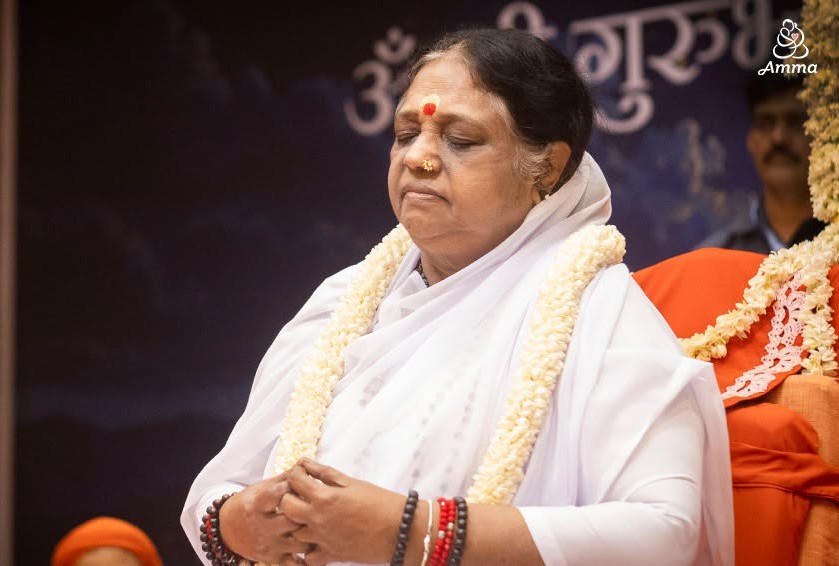
The movie Hanuman Ansch about the life of Neemkaroli Baba has taken India by storm. His life story is indeed amazing, yet not completely unique. India has brought forth many great personalities who were spiritually highly developed from childhood. Amma is another example.
The following is a chapter from my book “Thank you India”:
A woman in south India gave me the biography of Mata Amritanandamayi or simply Amma. She felt, I should see her. And indeed, Amma’s life story touched me deeply, maybe, because it referred to a time, when I was already on this earth. When she was born, I was already here, three years old.
Amma proved psychologists wrong who claim that lack of parental love will make a person distrustful and neurotic for the rest of her life. Sudhamani, as she was named, was the fourth of nine children of a poor family of the fishing community, who lived on a small stretch of land between the Arabian Sea and the backwaters in Parayakadavu village in Kerala. Her mother resented her right from birth on 27. September 1953. The reason: the new-born was unusually dark, besides being a girl.
After the 4th standard Sudhamani had to quit school to take over the household chores, as her mother had developed arthritis. Her brothers and sisters continued their education, while she, as the darkest of them, was treated as the family servant. Her day started at 3 a.m. and lasted till 11 p.m. and her mother was an unkind supervisor. She would beat her up even if one leaf was left in the courtyard after sweeping. Sudhamani also received many blows for giving away provisions from the family storeroom to villagers who were hungry. Yet Amma did not blame her mother for those numerous beatings. “She could not help it and did not know better”, she later said.
Sudhamani learnt early that the world had not much to offer. Yet she did not break, because she had tremendous support from within. It was her great devotion for Sri Krishna, to whom she poured out her heart at night in soulful songs.
It is inexplicable why this little girl had so much devotion for Krishna. Her family did not encourage it. Amma later said, “I would repeat Krishna’s name incessantly with every breath, and a constant flow of divine thoughts was kept up in my mind irrespective of the place where I was or the work I was attending to.”
Yet Sudhamani not only repeated Krishna’s name, she cried out to him, when she felt he was hiding from her and danced in ecstasy when she felt his presence. Her devotion was so intense that her family and villagers considered her strange, if not crazy.
In September 1975, at the age of 22, Sudhamani was on her way home from cutting grass for the cows. While passing a neighbouring courtyard, she heard the Srimad Bhagavata in praise of Sri Krishna being recited. Amma stood transfixed. The bundle of grass on her head fell to the ground and she rushed into the congregation. She felt that she was Krishna and this identification with Krishna expressed itself in her features and behaviour.
The villagers were convinced that Krishna had come to them in the form of this dark girl. The news spread like wildfire and sceptics came as well. Those sceptics demanded a miracle. When they promised they would not ask for any further miracle, Sudhamani relented, ‘Come next month when Srimad Bhagavata is recited again. I will show you a miracle.’ They came in droves; everywhere, in the courtyard, on trees, on the roof people had gathered, many expecting to expose the girl as a fraud.
Sudhamani asked for a pitcher of water and sprinkled the water on those present. Then she asked one of the sceptics to put his fingers into the water and lo, it had turned into milk. Another sceptic was called to put his fingers into the milk. Now the milk had turned into panchamritam, a type of sweet, with raisins and banana bits.
It sounds incredible. Yet times are changing or rather, science is changing. Some 40 years ago, when ‘scientific’ was the last word in the west, nobody dared to believe that miracles could really happen. There was the general view that miracles simply are not possible. It was the politically correct view. Today, quantum physics itself suggests that miracles are indeed possible and that strong thoughts have the power to manifest. People who witnessed this miracle are still alive and Amma herself would certainly not tolerate falsehood in her biography.
From then on, Amma showed herself as Krishna several times a week and people flocked to her from afar. Yet her tribulations even increased. During her identification with Krishna (Krishna Bhava), Amma danced in ecstasy and embraced everyone, women and men, young and old, high and low. This was too much for her elder brother, who was an avowed atheist and who regarded the family honour at stake.
Together with the sons of the landowner of the village, he founded a “Committee to Remove Blind Beliefs”. They recruited about 1000 ‘rationalists’ from the surrounding villages for their committee, which probably was not difficult in Kerala, which had been ruled by the Communist Party for long. Those ‘rationalists’ did everything to make life hell for Amma. “Here comes Krishna!” they taunted her when she passed by and even threw stones. They filed cases against her, got negative articles published in the media, offered her poisonous milk to drink (which she smilingly accepted and then vomited in front of them), took the help of a black magician and even hired a killer. Yet all their attempts to take her life and drive away her devotees failed.
Her own brother, with the help of some cousins, even tried to murder her. They lured her to an uncle’s house and locked themselves into a room. Sudhamani stayed calm, said they could kill her but only after she sat quietly in meditation – a last wish, she insisted, they had to grant her. This infuriated her would-be killers. A cousin advanced towards her and was about to stab a knife into her chest, when he himself collapsed on the floor with acute pain in his own chest. He died some days later, with Amma by his side consoling him. She did not have vengeful feelings. “He had to reap the fruit of his action”, she later said.
Amma meanwhile was even more intense in her devotion. Now, after having realised her oneness with Krishna, her longing was for Devi, the Divine Mother. She lived outdoors, as her brother had thrown her out of the house. She had only animals for company, neglected her body and behaved like a child desperately crying for her mother. One day, Devi appeared before her and, becoming dazzling effulgence, merged into her.
“From that day onwards, I could see nothing as different from my own formless Self,” Amma later said.
Slowly her opponents exhausted themselves and many even became devotees. Her elder brother contracted elephantiasis and committed suicide in 1978. Her father was greatly distressed about the death of his son. Amma consoled him. “Your son will be reborn in three years’ time as the son of Kasturi (his eldest daughter).” And she gave him already his future name, Shiva.
In February 2008, I happened to be in Amma’s ashram when she conducted a wedding. Members of the wedding party told me that it was Shiva’s wedding!
In the same year, 1978, when her brother had committed suicide, several young, educated men came to Amma, determined to live a spiritual life under her guidance, in most cases against the wishes of their well to do families.
Amma’s father, however, did not allow them to stay near Amma, fearing for the reputation of his still unmarried daughters. In 1981, when more people came, among them some foreigners, he relented and Amma agreed to form an ashram though she was not in favour of it earlier.
The Mata Amritanandamayi Math and Mission Trust was registered in May 1981 and started with a hut under palm trees on her father’s land. Her ashram has grown enormously over the last four decades. Some 2000 people reside there now, including around 500 foreigners, and as the land is limited, the pink buildings rise up 18 stories high. Colleges, schools, a hospital, even a swimming pool – for the students to learn swimming in this area full of water bodies – have come up and a bridge for pedestrians was constructed across the backwaters after the tsunami in 2004.
Amma is getting a lot of attention abroad. She represented India at the World Conference of Religions in Chicago, received a number of awards and was invited to speak at the United Nations. For the Cannes film festival in 2005 a film about her life was selected – made not by an Indian but by a Finn.
She has initiated a vast number of humanitarian and environmental projects and she is also in a unique position to improve the standing of women in society. She stresses the great potential, which is in them – she herself being the best example.
Reading her biography was amazing, yet it was the story of Dattan, the leper, which touched me most and which inspired me to travel to her in Kerala:
Dattan from the village Perumpally in Kerala became a victim of leprosy in his youth. His family turned him out of the house and he had to beg. The disease advanced and his whole body was covered with infected wounds oozing pus. He covered his body with a cloth which would stick to the wounds. Flies would constantly buzz around him. Other beggars would not let him eat or sleep in their company and villagers would hold their breath when they passed him. He could hardly see anymore, because his eyes had become narrow slits. For years on end, he did not hear a kind word. “I led a dreadfully miserable and despairing life. All my hopes had ebbed away”, he said.
Then he heard of Amma. He came during Devi Bhava to the temple, but the people around her urged him to go away. His wounds had a foul smell.
Amma however noticed him and called him near her. She pressed him to herself and comforted him. Then she licked the infected wounds and sucked the pus and blood from them. Some of her devotees, who witnessed it, vomited, others fainted and again others cried because of so much love and compassion.
From then on Dattan came to each Devi Bhava. Prior to it, Amma gave him a bath and rubbed holy ash over his body. His wounds healed, only the scars of his terrible sickness remained.
Amma said about Dattan, “Amma does not see his outer body. She sees only his heart. He is my son and I am his mother. Can a mother forsake her son?”
By Maria Wirth
link to Thank you India on Amazon.in
My latest book “Why Hindu Dharma is under attack by Muslims, Christians and the Left” is available on Amazon both in English and Hindi.
https://www.amazon.in/Hindu-Muslimon-Isaiyon-Vampanthion-Aakrman/dp/9391154832
