

This morning, unexpectedly, a Sadhu whom I had met in Gangotri in 2001 came to my mind. I had written a chapter about him in my first English book “Thank you India – a German woman’s journey to the wisdom of yoga”, published by Garuda Prakashan in 2018. In 2001, my life was in some turmoil, as I had left my Guru and tried to get some clarity. I stayed for three months in Gangotri.
I felt, the story of this Sadhu would be inspiring for others, and maybe I should put it on my blog, since not many have read my book and hardly anyone knows about it any longer.
So here is the chapter:
Insights from a VIP Sadhu
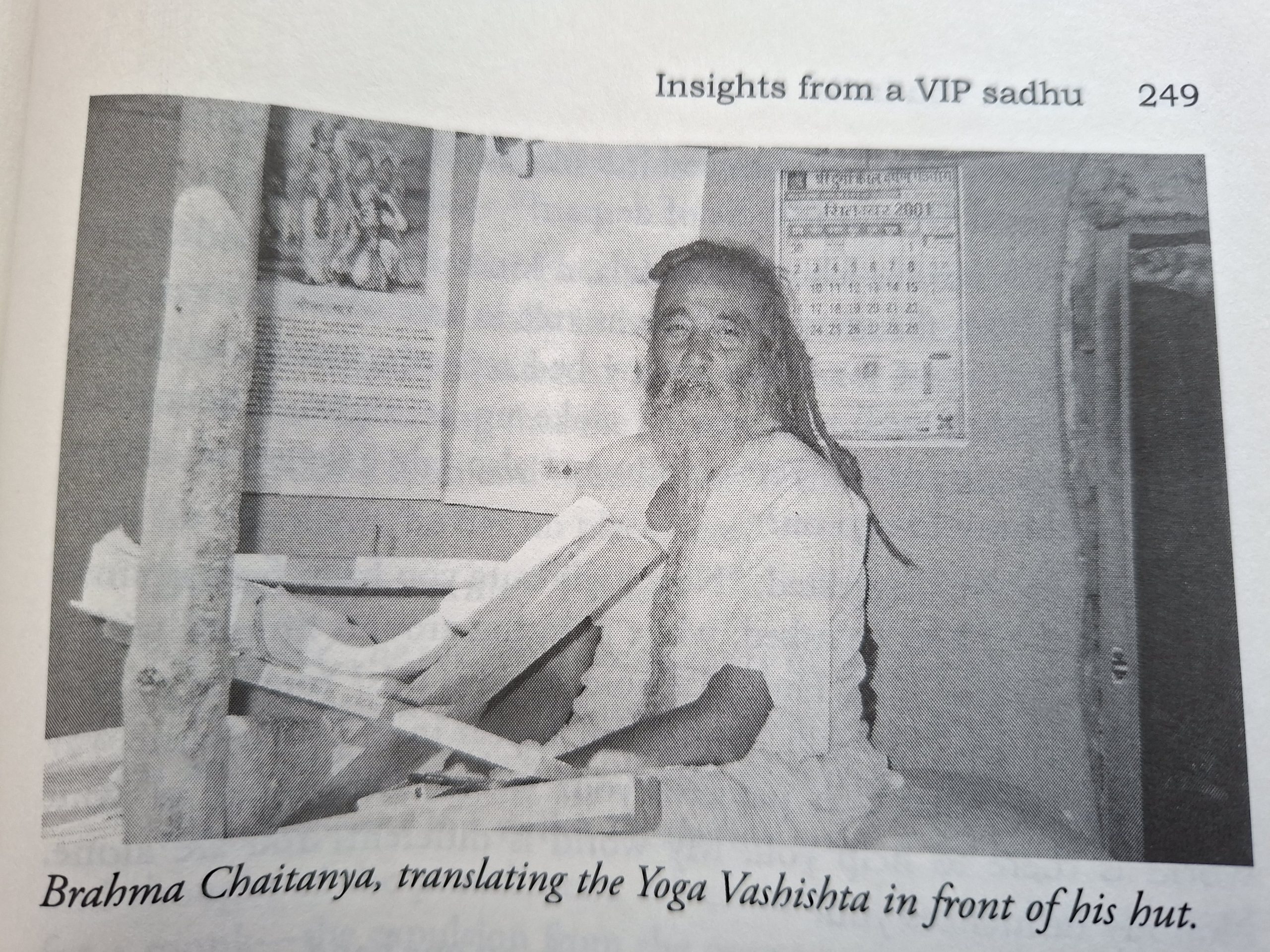
On the compound next to Yoga Niketan, right above the gorge of the Ganga, three sadhus were living in simple huts. One of those sadhus sat the whole day on his tiny veranda and devotedly scribbled into a big book placed on a wooden stand before him. Two more big books were spread out near him. He translated the Yoga Vashishtha into English using both the Hindi and Sanskrit versions for reference. The Yoga Vashishtha is an ancient teaching, which the guru Vashishtha imparted to Ram, the prince of Ayodhya, when he came back from a pilgrimage and had lost all interest in worldly life.
Prior to my trek to Gomukh, James, an American, who also lived in Yoga Niketan and daily visited the sadhu, had taken me along and introduced me to him.
Meanwhile James had left; and I went alone to Brahma Chaitanya or BC, as the sadhu was called. He was an impressive, powerful character in his late fifties, tall and strong, his matted hair so long, that he could use it as a cushion, his laughter louder than even the roar of the Ganga and his eyes sparkling with humour and charm. He was quite naturally a VIP among the sadhus and the president of the sadhu community in Gangotri. As he came from a wealthy family and had been an engineer, confident behaviour and commanding authority came easily to him and this self-assured conduct stayed with him as a sadhu.
Early in life, he became interested in spirituality, read a lot and practised pranayama, but he was young and did not want to be celibate. So, he married and had two children.
When he was in his late thirties, he however had enough of family life and, one fine day, left his wife and teenaged sons. He had thought about it for a long time and had tested himself, he explained. Then he was sure. He wanted to become a sadhu.
However, his wife traced him in Uttarkashi and was adamant that he came back home with her to sort out some inheritance issue. He yielded. Yet soon after, he left his family for good. His wife discovered him in Gangotri, too, but now she respected his wish.
He told me, what happened, when he begged for the first time:
It was in Haridwar. He still had a few hundred Rupees in his pocket, but now wanted to start his new life – without the safety net of a bank account and with full trust in providence. He stretched out his hand towards an elderly gentleman. As a reaction, he did not get any alms but a furious rebuke. “You should be ashamed, young man! Go to one of the ashrams which offer free food for sadhus!”
The newly baked sadhu was greatly annoyed, went straight into a restaurant and ordered a meal. Then he checked into a hotel. In the night, his conscience troubled him. “So quickly am I offended? Only because of a passing remark?”
Next morning, he gifted his travel case to a boy in the hotel and threw the rest of his money into the Ganges. “I now fully belong to you. You have to look after me now”, he told his Ganga Ma. From then on, he did not face any problems. He went to the centres, which served food to sadhus. He specifically mentioned that he joined the queue like everyone else.
The talks with him were highly interesting and he had, unexpectedly, an exquisite library in his hut – books by ancient and modern Indian and even Chinese masters, and by Zen- and Tibetan Buddhists.
Our conversations in the afternoon became routine and I looked forward to them. Afterwards he often dived into his hut and came back with a book in his hand. The first book he gave me to read was “Jnana Yoga” by Swami Vivekananda. It was that very first book that I had bought in Kanyakumari at the Vivekananda Memorial. Strangely, now it did not touch me so much anymore. Books like the “Shiva Sutras” or the “Spanda Karika” about the philosophy of Kashmir Shaivism, which flourished in Kashmir in the 11th century, I found now more appealing and enjoyed studying those texts in the beautiful surroundings at the height of over 3000 meters with snow-capped mountains standing guard.
BC made fun of the important looking, but unnecessary activities in the world and advised me, “Turn inward. You will enjoy it.” He handed me a poem of Chuang Tzu, a Chinese master, who had quite accurately described the ‘Active Life’ already over 2000 years ago:
“What would become of business without a market of fools? What would become of labour, if there were no superfluous objects to be made?” he asked for example already at that time. And his ironic advice: “Produce! Get results! Make money! Make friends! Make changes! Or you will die of despair!”
On BC’s advice, I bought a mala, a kind of rosary, made from 108 beads from the sacred Rudraksha tree in one of the shops near the temple and sat for hours on my bed repeating mantras. I was generally feeling well and when I woke up at night, I heard the mantra repeating itself. Yet sometimes I also felt heavy and down. How would my life go on?
One day BC suggested, “Now I will cure you from feeling small and unwell.” Then he asked, while pointing around himself with a sweeping gesture of his hand, “Whose world is this? Yours or mine?” And he answered himself, “Mine! You appear in it. In the same way is everything what you perceive your world. Everything in your world is there to help you. My world is different. You are alone. Nobody influences you.”
On one hand, he was right, but only on one hand, as everything that is put in words touches only one aspect of the truth. Certainly, no sentence can hold the truth.
Later, when he talked about virtual reality and informatics, he suddenly declared: “We all are only mechanic robots.” He mentioned scientific research, which claims that emotions depend on genes, hormones and so on. For example, the attraction between man and woman is based on testosterone and estrogen. “It just happens. You don’t have a part in it. You simply watch. Don’t get involved in what happens”, he advised.
I remembered that I had brought a bar of chocolate for him. “Do you eat chocolate?” I asked. Because sometimes he looked very holy, for example said, that he does not like conversing on worldly topics, and I considered it possible that he had renounced such worldly pleasures. “Yes, of course I eat chocolate”, he immediately replied.
He told me that once an American accused him of wasting his talent. “You should give lectures in the West”, he had said. BC answered him, “I have here everything I need. I get daily two meals.”
“Meals okay. But if you want chocolate, you have to do something for it”, the American had replied.
“Look! I even get chocolate!” he exclaimed and once again burst into roaring laughter.
BC was nice to me. He did not like to talk to other sadhus, because they were not really interested in spirituality, he said. “Most of them are sexually frustrated and some even keep women. They give an excuse by saying that the ancient rishis also had women.” He suddenly became loud and thundered, “If someone has not finished with his sex drive, he has no place here.”
“Do you shout at me?” I asked.
“No, never”, he suddenly became quiet, friendly, explaining. I felt that he might have shouted at himself. It probably was not always easy for him to stick to his vow of sexual abstinence.
“What happens if a sadhu breaks his vow of celibacy?” I asked and thought of the punishment, which in Buddhism was ordained for a monk – the expulsion from the monastery.
“Nothing happens. He falls, gets up and falls again.” He had made a slip of the tongue and hurriedly corrected himself, “and tries again.”
“Only few are really interested and do their work properly”, he said. “A doctor from Amma’s ashram, who runs up to Gangotri whenever Amma travels overseas, is one of them. He is genuine. A young woman is also genuine. She flew to Paris when she was 17 to learn fashion design. But this fancy world did not suit her. She informed her parents that she wanted to take sanyas. They were not pleased. They had money and wanted a comfortable life for their daughter. Yet she was determined and got her way. She lives now under very simple conditions here in Gangotri”, he said.
“You also belong to those who are genuine”, he flattered me and suggested to come earlier so that we had more time for our conversations, as he daily left at 4.30 in the afternoon for his food in an ashram.
I liked BC. He had those traits that I was lacking: strength, confidence and a loud voice. I had always been on the quiet, shy side and my voice does not become loud, even if I try.
“All spiritual seekers are unhappy”, BC declared out of the blue one day. “You, too”, he said and hit a tender spot. Was I happy? Not particularly, I had to admit. “They have the knowledge, but something holds them back”, he continued. “Be like a lion! Break free! What can the world give you? All faces are like in a movie. Don’t get entangled in the plot! When you die, the movie ends anyway. Throw the film roll away – now already! Throw out your thoughts! You are greater than the film, which consists of thoughts. Do your work well and sincerely. Let the others think what they want. Follow your conviction. Help is always available”, he encouraged me.
I sat either in front of my hut and studied ancient scriptures or inside and meditated. During the first few weeks in Gangotri, I made hardly any contact with others. It was an intense time, and it slowly became clearer to me what ‘pure awareness’ signifies.
“Look at those snow-capped peaks over there, but nevertheless stay with your awareness inside”, BC advised me. “Try to be aware of the unity behind the apparent duality – be aware of the white paper and also perceive the black print on it. Be attentive! Give your attention not mainly to the objects, but to attention itself”, he demanded. I tried it and got an idea what he meant.
Once he gave me the ‘Golden Letters’ by Garab Dorje, an ancient Tibetan master, after he had again dived into his hut. They were a treasure, like the Shiva Sutras, and I copied them by hand into my diary, because there was no copy machine in Gangotri.
The content of those letters is simple, yet very subtle. The main thing is to recognise that this fresh, immediate awareness of the present moment is the truth that is sought after. It is ever present – this ordinary, thought free awareness – now in this moment. Realise this ordinary awareness as your true nature and stay with it, because everything else, which means all appearances in this world, are only modifications of this basic awareness and therefore secondary.
BC shared my excitement regarding the Golden Letters. He suggested that during my next meditation I completely relax and then suddenly and loudly shout “Phat”. This would cause the pure awareness to rise up. In the evening, I tried it and it had a tremendous effect. It felt so beautiful that I didn’t want to move. Joy mixed with gratefulness. As if something had opened – an insight into my Self.
In the next morning a hint of bliss was still felt. Later it disappeared, yet now it was easier to discover it again. My own immediate, ever-present awareness had now become more familiar. I was sure that with time it would become dearer and dearer. I was grateful for this gift and better understood Ramana Maharshi’s saying: “You are always enlightened.” The true, inconceivable basis on which the mind builds its dreamlike castles is indeed always lovingly present.
BC suffered since long from back pain. One morning the pain became unbearable and he could not get out of bed. The doctor from Amma’s ashram advised him to go to the hospital in Rishikesh for a check-up and accompanied him.
When BC came back after a fortnight, he felt better and decided to stay in Gangotri for the winter as usual, even though everybody advised against it. It was only end of September and already ice-cold.
“Last year a Frenchman paid for my winter provisions”, he told me, and I knew why. I felt obliged.
“I will pay for it this year”, I offered. “How much is needed?”
“5000 Rupees are enough.”
I had not expected that much but had forgotten the cigarettes which he smoked one after the other.
Later I came to know that every November before the temple closes, a businessman from Punjab sends a truck with provisions up to Gangotri, which supplies the seven or eight sadhus who usually stay through the winter with their basic needs. BC had not given out this information. Yet I did not mind. He simply needed more than others. I was grateful, and money could not possibly compensate for what he had given me. Pure awareness as my own inner being had become more recognizable through the contact with him and his books.
Four years later, in August 2005, I went once again to Gangotri and looked forward to seeing BC.
“Brahma Chaitanya is no more”, the manager of Yoga Niketan informed me, even before he unlocked a hut for me. “He died completely unexpected last month in Delhi.”
I really felt sorry. He had been so full of strength and life. I did not understand how he could have gone to Delhi in the hottest season. He himself had told me that he would not leave Gangotri again. Only his ash would be carried down into the plains by his Ganga Ma.
I heard two versions why he went to Delhi in the peak of summer:
A well-known, ‘big’ Swami from Delhi wanted to meet him and sent two of his followers to Gangotri to request him to come. BC declined. However, they came again and urged him. That time he yielded, maybe because the Swami had offered to arrange an Ayurvedic treatment for him. Yet nobody knew why the Swami wanted to meet him.
The other version said that BC wanted to go to Delhi on his own wish for Ayurvedic treatment and the Swami arranged it for him.
It would surprise me, if BC had wanted to do a treatment in Delhi in the hottest time of the year. I had been in Delhi in that same June for a short while. The temperature was 46 degrees Celsius and took a huge toll from every body, even more from a body that, since a couple of decades, was used to the cold climate at the height of above 3000 meters.
“Death called him to Delhi”, a sadhu neighbour of BC said and thus put any speculation that there might have been some foul play into a different perspective. “His time had come.”
BC’s sons came to Gangotri and took the translation of the Yoga Vashishtha out of his hut. Their father had given his life to this work. The ash of BC was immersed in his beloved Ganga Ma – in Haridwar, where he had started his sadhu life. The circle had come full round – an inspiring life had ended…
By Maria Wirth
link to buy the book presently for Rs 349 instead of 499
https://garudalife.in/thank-you-india-by-maria-wirth
also available on Padhega India
https://www.padhegaindia.in/product/thank-you-india-a-german-womans-journey-to-the-wisdom-of-yoga/
and also on amazon for Rs 440
my latest book in English July 2025 by Vitasta, “Why Hindu Dharma is under attack by Muslims, Christians and the Left”

7 Comments
Very emotinal write up Maria ji! It is like feeling spiritual feeling on reading this chapter abot life of Sri Brahma Chiatnya ji! It is part of one’s previous Karma! Om Sri Hari Vishnu!
Hey Maria , you met a great soul yet so human, in your life time. Happy for you as you came closer to glimpse of atma shakshatkar, self realization. You motivate many others with life as a seeker. Jai Maa Ganga
Enlighting spiritual journey of a seeker Sri Brahma Chaitanya ji🙏
Thank you Maria ji
Nice.. I came to your this blog via email. Nicely written. BC must be really a little evolved sadhu, He may have put some sukshma control he might have learnt which helped you in meditation – that Phat expereince.
While I am not surprised about a sadhu like BC so evolved, What he talked with you most of it is out of understanding one develops from books like Yoga Vasishtha. That book opens a different world for a person. You may have also perhaps read later?
Most pleasant was learning via this article that you are also quite evolved. I interact with you some times on FB. But never even tried to look at you in this light. It is nice to learn that you have achieved this type of calm detached style and can get away from usual mind games, so effortlessly..
BC really was very admirer of Swami Vivekananda JYAN YOGA book. Iam shocked that he could not see his translated Yoga Vaishista in to Book Form. He gone early. Maria why do not write about Vivekananda Life. You must write. Did you ever met of Ramakrishna Saradamission Dakshineswar Kolkata Pravrajika Prabudhaprana Mataji who is a Ametican nun jined Sarada Mission and written many book .?
no i have not met. but i wrote for Advaita Ashram magazine. i put it on my blog, too: please search “science and religion” on the homepage of my blog
Maria ji, Good to learn that you learnt a lot from BC. We cannot and should not Judge someone, because every Aatma is on its journey to meet Parmaatma. I met Bhramleen Param Shreddhye Swamy Shri Ramsukhdas ji Maharaj at Gita Bhavan #3 in Swargaashram. He has written most comprehensive commentry on Shrimad Bhagavad Gita with name Saadhak Sanjeevani. An excellent ” Saadhan” for Seekers, which enables a seeker to realize godliness in his/her home …