

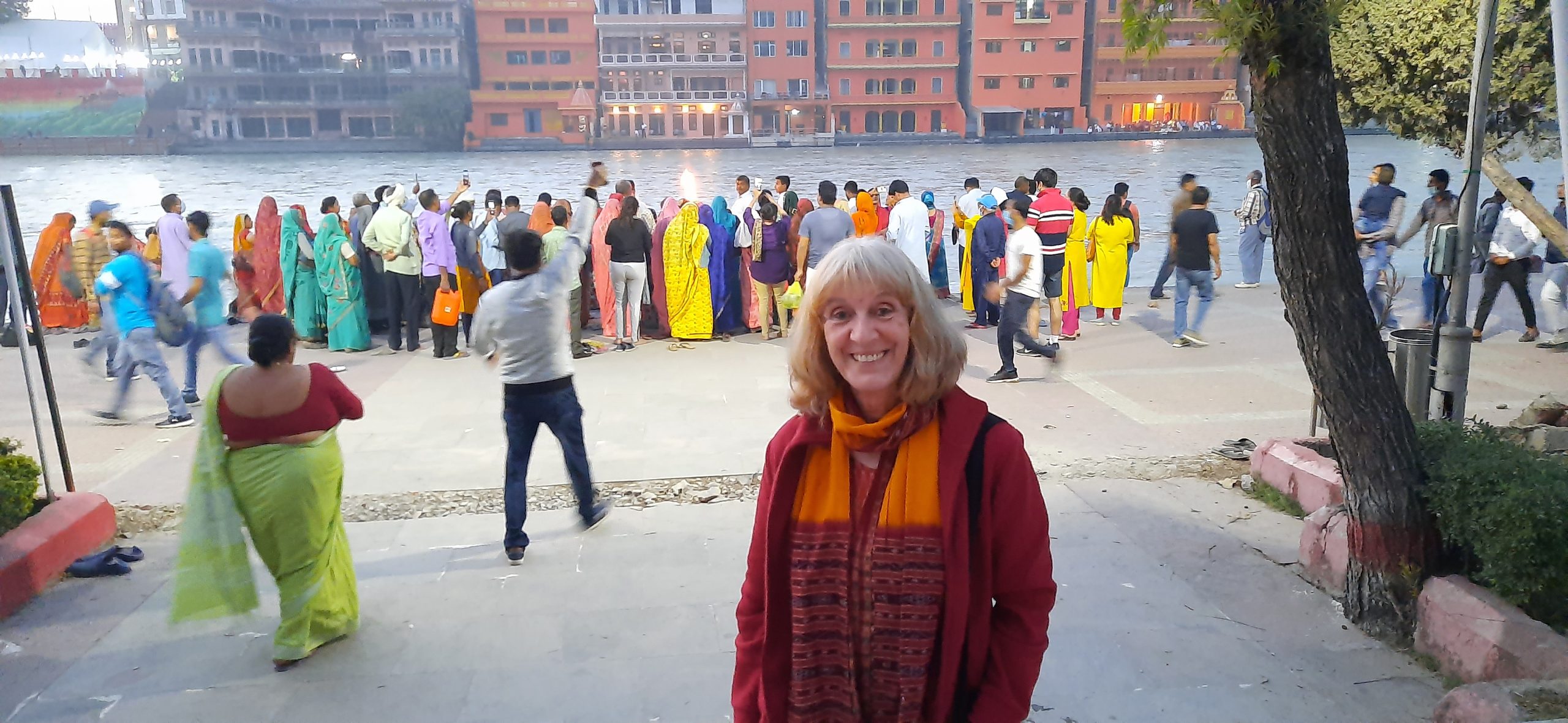
This interview conducted by Varsha Panth from newsgram was via zoom, but my internet connectivity was bad. AI put it into writing. So it is quite long and in very colloquial language. You can scroll and see which Question interests you.
Here is the interview, originally published on newsgram:
Maria Wirth is a writer and author originally from Germany. She studied psychology at Hamburg University and worked with Lufthansa in her early years, which allowed her to travel across many countries, from Chile to Indonesia. In 1980, Maria came to India for what was meant to be a short stopover on her way to Australia. However, her life changed when she experienced India’s spiritual traditions. Deeply inspired, she decided to stay and spent many years living a simple life in ashrams and spiritual communities.
In this interview with Varsha Pant, Wirth speaks about her new book ‘Why Hindu Dharma Is Under Attack by Muslims, Christians, and the Left’ and also shares her views on Indian spirituality, the concept of Hindutva, Problems with Islam, and the future of Hinduism. The conversation went as follows:
Q
Please tell us about yourself and your personal spiritual journey, from Christianity to Indian philosophy and Hinduism. What was it about Hinduism that fascinated you so deeply that you decided to stay in India? Also, in your view, what is the true definition of Hinduism, and how is it different from the way it is commonly understood today?
A
Well, I always had questions when I was a teenager. I always wanted to know “What is life meant for?”. And I couldn’t get answers. I used to discuss with the priest in religious class, and I just couldn’t get answers. I lost my faith in Christianity because I couldn’t believe that God could send somebody eternally to hell. Hell made a big impression on me as a child. But I felt there must be a great power. So I never really lost my faith in God, if you want to call it God. So when I came to India, suddenly everything made so much sense, because here it is explained.
As a Christian also, I was talking to God within. But God was supposed to be somewhere above the clouds in heaven, and I could never understand how that works. In India, suddenly I hear: “Bhagwan is inside in the form of consciousness.” This made a lot of sense and impressed me so much because, if you think about it, what is the most important thing in our life? I mentioned it also in my book: Imagine God, or a king, says to you, ‘You can have everything you want. I will give you everything. Just tell me your wishes. But there is one condition: you won’t be conscious.’ Would you accept? Would you accept a big house, a beautiful husband, all the money, all the high positions, if you are not conscious?
We never think about this. We take consciousness for granted. And by consciousness, I mean what makes thinking possible. It is the basis of the mind. When I heard about Advaita Vedanta, the Indian philosophy, it immediately made sense. It was like, wow! I was so happy. Suddenly, I didn’t have questions anymore about the meaning of life or about what is important. I felt that if this consciousness is my essence, then I should find out who I really am. “Who am I?” is the most important question in Hindu Dharma.
Indian philosophy impressed me so much, and that’s why I write, because I feel that in the West, this knowledge is lacking. And now, I feel that even in India, especially among youngsters, many don’t know about it anymore. They are not aware what great treasure they have. You don’t even have to study much. Just reflect a little on what is true—what is true about myself. Nowadays, we don’t do this, because of our mobiles. We are always looking outside, and it has become much more difficult to look inside.
When I came to India, I used to sit for one hour in the morning and one hour in the evening for meditation. Now, I have to admit, I don’t do it anymore. So much information is coming in. I want to know about the situation in the world, and it is important to know about current events. But it is most important that we know what our essence is. If we have this anchor, then we can be interested in what is happening, things like the Epstein files and so on. The world is in a bad shape nowadays. We should be aware of it, but we should not forget the most important connection, which is with our true Self—Bhagwan, Brahman, Ishvara, God, whatever you want to call it. Names don’t matter.
Have you heard of this concept of Brahman earlier? Did you know about it? I met some students at a conference a few years ago. During tea break, I asked them, ‘Can you explain what Hinduism is about?’ One girl said, ‘We worship many gods.’ I asked, ‘And who created the many gods?’ There was silence. Then I asked, ‘Have you ever heard of Brahman? I don’t mean Brahma, Vishnu, and Shiva—the Creator, Sustainer, and Destroyer—the trinity, but the all-encompassing Brahman’. Nobody had heard about it. I was so shocked. It is YOUR (Indian) knowledge.
In the West, many philosophers benefited from this knowledge. Now nobody mentions it. I feel what is happening is that they want to control us. For that, we have to lose our connection to God, to Bhagwan. Then we can be controlled. Then we are afraid to die, and we do everything for security. That is not a good state. So, the main thing is that we have to find this inner connection. Then life becomes easier. It will not always be easy—difficult times will come—but you have an anchor. I recently talked with some German friends, and we all agreed that we are very grateful to India for this knowledge. Unfortunately, many young Indians and even old Indians don’t know about it anymore.
I think it is easier for Indians to understand Advaita Vedanta. I was once in an ashram in Telangana or Andhra Pradesh, very far off, at the end of the road near the mountains. It was the ashram of Karunamayi. A bus came with villagers, and I was the only foreigner there. The children ran up the steps, saw me, and ran back to their mothers because they probably had never seen a foreigner. Karunamayi came to the temple and gave a talk in Kannada. I don’t understand Kannada, but I understood one sentence.
She said the temple was for Lalita—Lalita Ambika, Devi, Shakti. The innate female power in Brahman that creates everything. She said, ‘Lalita Chaitanya Rupa’—Lalita is in the form of consciousness. At that moment, I thought, if you tell this to Westerners, even ones with a PhD, they will be confused: ‘What does it mean that God is in the form of consciousness?’ But I felt the villagers understood it. Maybe Indians who go through the English education system are more like Westerners and actually are at a disadvantage.
The problem with Islam is that in the scripture, in the Quran, there are many verses which are very much against others, against those who are not Muslims. It says Allah will accept only Muslims. If you are not Muslim, then you will not be accepted. So when someone is a Muslim and hears this, and thinks that Allah wants only Muslims on Earth, then of course he may not be nice to others.
Maria Wirth on Islam
As a Christian, I felt God within, but couldn’t understand Him as distant in heaven. In India, I learned that God lives inside us as consciousness.
Q
In your book, you mention how the concepts of Hinduism and Hindutva are often misunderstood—where Hinduism is seen as “good” while Hindutva is portrayed as “bad.” How has this distinction come about, and what are the main reasons behind this perception? Why do you think both these concepts are widely attacked or misunderstood today?
A
I don’t see any difference between Hinduism and Hindutva. The British coined Hinduism, which is actually not correct, because an -ism usually means a dogma. Communism and socialism, it is always about a dogma. Hinduism is not dogmatic. It is very open. So ‘Hindutva’ (Hindu-ness) is a better word than ‘Hinduism.’
What I noticed, and my book is also about this—the title is ‘Why Hindu Dharma Is Under Attack by Muslims, Christians, and the Left’—is that the attacks became stronger after Hindus became aware that actually, Hinduism and Hindutva are good. Missionaries told Indians, ‘You have a very primitive religion. You worship nature and many gods. You should adopt Christianity.’ Then, around the year 2000, when the internet became stronger, there was a talk about Internet Hindu. Hindus could suddenly connect and say, ‘Actually, we have a very good philosophy, a very good tradition with so much knowledge. We can be proud of it.’
When this movement came up, suddenly people started saying, ‘These Hindutvavadis are bad people. They want to throw out Muslims and Christians.’ Nothing of the sort! Hindutva means Hindu-ness, and the essence of Hindu Dharma is that this consciousness—Bhagwan, God—is in everyone. Absolutely in everyone, whether you are Christian, Muslim, Jewish, or anything else. It doesn’t matter. It is most inclusive. I did not understand why those ‘Internet Hindus’ were so badly attacked. Even I was personally attacked.
My neighbor was a communist from West Bengal. He had a Brahmin name. He used to introduce me to his friends as ‘the local RSS pracharak’ and it sounded like a smear. I didn’t know what RSS was then, but I thought it must be good, if it agrees with my views. People try to make it look bad, as if RSS is against others. This is a misunderstanding. Not only a misunderstanding, but a conscious one. They don’t want to know the truth. They want to attack Hindu Dharma because, if Christians or Muslims really became aware of what great knowledge is here, they would at least become half Hindu. It makes much more sense—respecting rishis, respecting life, ideally not eating animals. I find vegetarianism very important. We are so insensitive when we think we can kill animals just for taste.
People say, ‘Everyone has free choice.’ But you don’t have free choice if it affects the life of another being. Animals are also beings. And this needs to be discussed, and actually in the west there are now discussions about it. But unfortunately, in India more and more people started eating meat. If it’s necessary, like in cold areas, it is okay, but if there is no need for it, why kill? This respect for human life, animal life, and nature is a very beautiful aspect of Hinduism, Hindutva.
For 20 years, I lived mainly in ashrams. I thought every Indian knew what great treasure they had. Then I came into a normal environment and realized that many people were very negative about Hinduism. Most of them were English-speaking and had gone through the education system. They had been taught to look down on their own tradition. I had not realised this earlier because when I came to India I thought ‘wow, what great knowledge is here’. Recently, a CIA document, declassified in 2016, talked about cultural trends in India. It said that apart from village worship, Hinduism has a very sophisticated philosophical and ethical system in Vedanta, in the Upanishads. The deep state know this. So why don’t they research and spread it? Instead, they attack it. I feel the reason is that they want to cut us off from our connection with the divine. That is the main purpose.
If you see what is happening in the world now, the top ‘elites’ around Epstein are very depraved. It is very bad. It is Kali yuga. But that doesn’t mean we have to fall into depression. We should stand up for what is true and for a dharmic life. So, feel proud to be a Hindu. Some people feel ‘Hindu’ is not a good word and call themselves ‘Sanatani.’ But we should be careful. ‘Sanatani’ sounds very close to ‘satanic’. Westerners don’t know what ‘Sanatani’ means. They may automatically think of ‘satanic.’ Not because they want to insult us, but because that is the word they know. So, we should be careful not to give anyone a handle to call us satanic, demonic. In India, it is no problem. But internationally, people sometimes say, Hindus worship demons. Some Christian priests and podcasters say this. But it is completely wrong. Hindu Dharma is the very opposite of satanic.
Q
Why do you think many people from other religions find it difficult to understand or accept Hinduism? Could you explain some of the common myths and misunderstandings about Hinduism today, especially regarding idol worship?
A
In Hindu Dharma, there are basically two levels. There is one level of “Advaita” which means not two, it is the one consciousness which is permeating everything and encompassing everything. It is Brahman, or Ishvara, or Paramatman, or Tat. It doesn’t matter what name you give it. The Vedas say it cannot be put into words, but it really exists. I often use an analogy given by Ramana Maharshi. He used to live in Tiruvannamalai and left his body in 1950. He gave a very nice analogy. He said, imagine a screen in a movie hall. A white screen, nothing on it.
Now the movie is projected. You see so many people, houses, so many things moving on the screen, yet the screen is now hidden. But if you touch any person or object in the movie, you touch only the screen. The essence of everything, including us, is the screen, that is real and solid. The movie is just a flicker. It comes and goes. So Hindu Dharma says there are two aspects. One is the screen—Brahman. It is true, eternal, one, with no distinction, hidden under the movie. And then you have Maya. In Maya, everything is temporary. It appears real, but is not really real. The analogy is not perfect, because in the case of Brahman and Maya, Brahman itself creates the movie or Maya. There is no projector from outside. The screen itself creates the movie with the help of Shakti. So, these two levels of absolute truth and relative truth, we should keep in mind.
In Maya, there are not only human beings. There are also Devas, Asuras, and Rakshasas. In Hindu Dharma, Devas are worshipped. Not asuras and rakshasas. The temples are for Devas. Devas stand for sattva, purity. Asura stands for rajas, ego and Rakshasas for tamas, ignorance, darkness. Even the trinity of Brahma, Vishnu, and Shiva are Devas. They are not eternal. Only Brahman is eternal. But they live very long and have much more power than humans. There are also other beings like the saptah rishis and many others are mentioned in the Puranas.
I think we should take the existence of other beings seriously. Human perception is very limited. We see only a small bandwidth of what is really there. Hindus have been in touch with the devas and rightly worship them, because they are helpful in Maya—Surya for example, Chandra (moon) and the elements. India was very far-sighted. You knew about the five elements, but how did you know about them? You knew about the constellations in the sky, but how did you know about them? You also had a long history with great spiritual personalities or Avatars, like Krishna and Rama.
When you worship Devas, Christians, Muslims, and Jews say, ‘Oh, they worship other gods.’ They don’t realise that the God they worship is on the level of Devas, because they don’t have this eternal level in their understanding. They see only God in heaven, watching us, and Satan trying to tempt us, so, it’s all in maya only. Their whole religion is about believing in a story. They don’t consider what makes thinking possible. They [Followers of Abrahamic Faiths] think, ‘You worship Krishna, Rama, Ganesh, Shiva, Surya—so many forms. How can that be right? There is only one God.’ In one sense, they are right. There is only one God, one ultimate source. But Hindus also believe that or rather discovered that. Hindus postulate one God/ Brahman as essence of everything. Brahman contains everything—the Devas and everything what appears in the movie on the screen.
If we could explain this well, I think people from Abrahamic religions would understand. How can you say, ‘Only if you get baptized, you will be saved,’ or ‘Only if you become Muslim, you will be saved’? That doesn’t make sense. It is not possible. It doesn’t seem right.
Q
You have been outspoken about your criticism of Islam and the concept of jihad, and you have discussed these views in your book. How do you view Islam as a religion and the ideas behind it? What, in your opinion, leads to intolerance or violence in its interpretation?
A
The problem with Islam is, that in the scripture, in the Quran, there are many verses which are very much against others, against those who are not Muslims. It says Allah will accept only Muslims. If you are not Muslim, then you will not be accepted. So when someone is a Muslim and hears this, and thinks that Allah wants only Muslims on Earth, then of course he may not be nice to others. If he believes that God doesn’t like us, then naturally he may think he can also be bad to us, cheat us, or not be nice to us. If someone strongly believes what is written in the book, this can happen.
But there are many people who have never even read the Quran and who are just normal human beings. They have a conscience. They know that you don’t kill other people, you don’t cheat other people. This is ingrained in human nature. But if somebody is very much indoctrinated, then he will put his conscience aside and say, ‘Yes, let’s do jihad,’ “let’s do Allah’s will.” And this is very dangerous.
Recently, with all these Epstein files and what else is coming out about the deep state, and about ISIS and Al-Qaeda, I am coming more and more to the conclusion that Muslims are most likely instigated to riot and do jihad. Their leaders may be paid. See what happened in Bangladesh—it is terrible. I wonder what this deep state is doing, pushing people to fight each other. Muslims, Christians, Hindus, Left and Right—worldwide, they want us to fight each other. And I am coming more and more to the conclusion that we have to try to find commonalities among us common people and be aware of who is actually controlling us, who really has the power and all the money in the world.
I know Muslims can be dangerous. When clerics say, ‘It is written in the book, it is God’s word, you cannot change it.’ Then followers may think, ‘We have to get rid of all these Hindus.’ That is wrong. There is also a theory that Islam was originally created to get rid of Christianity. When Islam began, they went to Syria and killed the Christians there and then to North Africa, even Spain, and then to India. Some people say it was created to make us fight among each other. I don’t know if that is true but it is possible.
But look, for 2,000 years, people have been claiming, ‘God loves only us’—Christians, Muslims, Jews. How can that be true? Why has nobody said, ‘This is nonsense’? Can’t we stop this? Can’t we all be friends? Can’t we just be normal human beings? Why indoctrinate our minds with ‘God wants this, God wants that,’ when it makes no sense? I don’t think God wants us to kill each other. If we could make people understand this, it would be great for humanity.
Q
You have mentioned the Rashtriya Swayamsevak Sangh (RSS). What are your views on the role of the RSS in Indian society? Also, how do you see the Ghar Wapsi movement?
A
I find the Ghar Wapsi movement very important. The problem is that I know from my own experience, growing up in Germany as a Christian, that we were taught in school that our ancestors were very primitive. That they used to think that God was angry, when there was a thunderstorm, etc. So the teacher and the priest would tell us, ‘Look, now you are so lucky. Now you have the true God. But your ancestors were very primitive.’ The problem is now that Indian Christians and Indian Muslims, in all likelihood, were also taught a similar thing. ‘You know, these Hindus—you can forget about them. They are just so primitive. They worship so many gods and even strange gods.’
I think at the same time, there are always people who have the capacity to reflect. And if a certain number of such people would reflect and say, ‘Yes, Vedanta makes sense.’ Truth is like the screen in a movie. Brahman is eternal, always one, and we are now in this virtual reality or Maya. Elon Musk also talks about our reality being like virtual reality and not the real truth. So, I feel we have to make people understand. That’s why I said in my book that a misunderstanding killed millions of Hindus – the misunderstanding is that Hindus worship other gods. Worshipping other Gods besides the ‘true God’ is considered as the worst sin in Abrahamic religions. They don’t understand that the Devas within Maya are all in essence only the ONE Brahman.
Yahweh, God, Allah— all three demand, ‘worship only me.’ It means they acknowledge that there are other gods. They are within Maya. This is not rational and not helpful for humanity as a whole. That’s why I keep saying that Hindu Dharma is the best option for humanity, because it includes everybody.
They [Followers of Abrahamic Faiths] think, ‘You worship Krishna, Rama, Ganesh, Shiva, Surya—so many forms. How can that be right? There is only one God.’ In one sense, they are right. There is only one God. But Hindus also believe that. Hindus have one God/ Brahman an the essence of everything. Brahman contains everything—the devas and whatever else appears in the movie(Maya), including our persons.
Maria Wirth on polytheism
Q
You explained the concepts of Brahman and Maya, where Brahman is the ultimate reality and everything that happens appears on the “white screen” of consciousness. If all existence is part of the same truth, then what is the need for communal hatred or violence?
A
Exactly. There’s no need for this. I think people want us to fight against each other, so that we don’t look at who or what is manipulating and trying to control us. And also, that we forget about our connection to God within. We are working on computers, earning a little money, paying our bills, and trying to look after our families. And then there are these people who have billions—trillions we cannot even imagine—who seem to be more like the asuras of the Puranas, who don’t have the wellbeing of humanity at heart.
These asura-type persons want us to keep fighting. We should not fall into the trap. It’s important to follow Dharma and call for the help of the Devas – and never forget our connection to the screen, by whatever name we call it. Actually, nama-japa is a powerful means to keep in touch.
Q
On that note, do you think dharma truly prevails in India today? Do you believe that Hindu people in India are genuinely following dharmic values in their actions and decisions?
A
Well attempts are on disconnect Indians from Dharma—like this wokeism. Especially Hindu youth are in danger from foreign forces, which push wokeism, and LGBT, atheism, as they want to be ‘modern’. Now people go to the mall. Earlier, they would go for bhajans. But now, bhajan is coming back, I hear, and this is a good thing. I heard about bhajan clubbing, where people don’t go for heavy music but devotional music.
Even in Germany, bhajan is becoming popular. So I think people long to have a connection with God, with Bhagwan. If we don’t have it, we lack something. Then we have to look for something else. We need entertainment, we always have to do something. I wish Indians would still have this knowledge, and I think there are still many people who have special powers, like sadhus. India is a special country because the pursuit of truth is still very prominent.
In the West, there is no universal truth now. ‘Everybody has his own truth’, people there claim. We are very much lost in the West. India is still much better, but attempts are very strong to push Indians away from their traditions and from this connection.
Q
India is often described as a global spiritual center, yet spirituality seems to be declining in everyday life today. Why do you think this is happening? Also, do you think many people in India who are poor and are struggling have the time to think about spirituality?
A
I had a help. She was cooking for me every second day—dal—because I’m too lazy to cook dal, and dal is important when you don’t eat meat. So once she was telling me that nowadays people don’t know any longer that what they do has an effect on themselves. That is a very deep knowledge about karma. This knowledge is still ingrained in many Indians. And look, when you go to a pilgrimage place, you don’t have to worry. You can leave your bag, even if people are poor. This knowledge—that you should be a decent human being—is still here because people still know there is a Bhagwan. Trust in Him is still there.
In the West, there is a historian from Israel who is very famous. He is at the World Economic Forum. He was even here on TV, I think on India Today, and was presented as a very prominent historian. He says it is ridiculous to believe in God or a soul. He is important in the World Economic Forum, so you can see what they want us to believe. And it is wrong. He is wrong. Maybe some people think, ‘Oh, he’s so famous, he must be right.’ But he’s wrong.
Many people say India is very poor, but India is not so poor. Look at what you can buy for your money. If you have a salary of ₹60,000, that equals about €2,000 or €3,000 in Germany—that is ₹2 lakh or ₹3 lakh. So when we say poor, it is relative. Life is much easier in the sense that it is full of festivities. There is so much decoration, colourful lights, beautiful music, whether it is a religious festival or not. There is so much joy. Imagine small children growing up in this joyful atmosphere.
In the West, we have done away with everything. We basically have no festivals. This liveliness is missing. In India, there are bhajans, pilgrimage places, and beautiful temples. Everybody can go out and buy a small snack on the roadside. Most people can afford it because it is not expensive. In the West, everything is expensive. So when people keep saying India is such a poor country, I don’t agree. It is not only about GDP. If we want a higher GDP, everything has to become more expensive.
Q
India faces many serious challenges today, including corruption, crime, pollution, and national security concerns. In light of these issues, do you think India can truly become a Vishwaguru (a global spiritual and moral leader)?
A
India should be the Vishwa Guru because it has the knowledge – the knowledge that everything is contained in pure Consciousness, everything is included. And we are all the same in essence. We are not the same outwardly. We have different paths, everybody. We have different talents. You cannot say everybody is the same in this Maya. But our essence is the same. That means you respect everybody. So, the knowledge for being the Vishwa Guru is here. But I think, asuric/ adharmic forces want to disconnect us from Dharma and from this knowledge, so that we can also be easily controlled. I hope they won’t be successful. We should explain in a very simple and easy way what knowledge is here which is lacking elsewhere. Like I was so impressed when I first heard about this deep knowledge, others many also be impressed.
Q
In your book, you have mentioned several spiritual leaders who have inspired you in India. You also describe a special instance when you were deeply impressed by Dhirendra Krishna Shastri (Bageshwar Baba). Could you share that experience with us?
A
It was strange because I was flying back from Khajuraho to Delhi. I had not heard of Bageshwar Baba. There was a young swami walking with us to the plane—it was a small airport. One woman told me, ‘My God, we are so lucky. He is coming with us, flying with us. So many people want to see him.’ And I didn’t know who he was. When we landed, people were standing around him, very close. I took a photo of him.
Afterwards, when he went to Bihar, I realised, my God, millions come to see him. I feel, that he has the power to see things that are not easily seen. Some people say it is all fake and that he is cheating, but I don’t think he is cheating. I am convinced that psychic powers are possible, definitely. He also says very clearly that India is a Hindu Rashtra, which many Hindus appreciate. He says people should be proud to be Hindu and not convert for whatever reason. He is young, and so many youngsters come to him. I feel his influence is a very good thing.
Q
There have been many controversies surrounding Dhirendra Krishna Shastri and his views on women. What is your perspective on these debates? Additionally, what are your views on modern feminism and how it has moved away from its original purpose? In your opinion, what is missing in today’s gender equality movement?
A
It was in 2024, that I saw him. I have not followed what he has been saying in the last two years. So I don’t really know what he says.
But regarding feminism, I feel it went too far. When I was young, feminism started in Germany. I was not happy with it because some feminists wanted women to go to the army. I didn’t want to go to the army. In Germany at that time, we had mandatory military service for boys for 18 months. And the feminists wanted women also to go.
I think feminism has now gone too far. In a relationship, somebody has to give in. I remember discussions when we were young: suppose, the husband gets a transfer to another city, why should the wife go with him? The wife has her friends here, so why should she go? But somebody has to give in. If you start fighting from the start, then better don’t marry. Be alone.
I was recently at a girls’ college, and a police officer was talking about how girls should be careful. He said they should not expose themselves. Then a girl asked, ‘Why only girls? Why don’t you tell boys?’ And he said, ‘We tell the boys also.’ But her attitude was, ‘Why should I not wear whatever I like?’
When I see girls in miniskirts, I feel they would be much more comfortable in a salwar. They could move more easily. There should be some common sense, instead of just following the West. West is not the best. In the West, we have gone into a wrong direction. Now, when you see drag queens and people saying they are dogs and behave like dogs… when you follow what is happening in the West, it is bad—very unreasonable. I would not want India to go in the same direction.
Regarding men and women— sometimes giving in is not a bad quality. Unfortunately, this is not what is recommended. When I mentioned earlier, they want us to fight each other – ‘men and women’ also should be added. Laws which favour exclusively women and don’t even listen to the men’s arguments are in my view not fair. Such laws can be easily misused.
An example:
A taxi driver once told me that he picked up a woman in Delhi when he was returning empty to Uttarakhand. She got quickly into the car and said, ‘Straight, straight.’ He said, ‘Tell me where you want to go. Otherwise, I will drop you here.’ Then she said, ‘Okay, you can drop me, but only if you give me ₹300.’ He was shocked. He said he would call the police. Then she said, ‘I will tell the police what you did to me.’ He knew the police would believe her, so he felt trapped. He gave her ₹300 and she left.
It should not be like this. It is a very sad situation. Thinking, ‘Because the law is on my side, I can do whatever I want,’ is wrong.
Q
We have discussed many important issues—from the true essence of Hinduism to Hindutva, feminism, and your views on Islam and Christianity. In light of all this, what do you think is the future of Hinduism in India? How can Hindus preserve and strengthen their spiritual and cultural heritage in the coming years?
A
Well, the most important thing is that we do some sadhana. To sometimes stop and try to recover this inner essence, and develop love for it. It is about Jnana, Bhakti, Karma, and Dhyana, meditation. Meditation means sometimes going inside. This is most important—that we have some experience. Yes, there is a beautiful state within us. It is love. It is an expansion. Sometimes, when you wake up in the morning, when you are not yet fully you, when you don’t think yet, and you just feel, you get an inkling maybe, what that state is. I really think it is love. Somebody once said, “The only real thing is limitless love, and this is the screen.” Brahman.
It is in all of us, but it is hidden. In this play of Maya, they try to put it away, but it cannot be erased. I think that is what is meant by Satyameva Jayate. This screen cannot be deleted. It is always present, and we have to uncover it—discover our essence.
For the future of Hinduism, the main thing is that Hindus first need to do sadhana. They need to discover their essence. Do some meditation, do some yoga, read books like Bhagavad Gita and do nama-japa. And then also explain this wisdom to others—that we are not idol worshippers in their sense, that we are not sinners. What we are doing makes great sense. The god of the Abrahamic religions is basically a tribal god. If a god loves only one group, he must be a tribal god. He cannot be the universal God, isn’t it?
That is why I feel India has to become the Jagat Guru, because India has this inclusiveness. It is for everyone. It is not exclusivist. It does not say, “If you don’t follow this guru, this son of God, or this prophet, then sorry you go to hell.” We should be capable of making people understand that this is really nonsense—ridiculous.
We have to say it. Somehow we are shy to talk about religion. But it is not insulting; it is putting facts on the table. A Christian or Muslim has no problem saying, “You go to hell if you don’t convert.” That doesn’t make sense, isn’t it? Yet we don’t counter. We avoid a debate. But we should have the confidence to come and explain in a friendly way—not confrontational.
We should say: You are human first, no? It is possible that what you believe is the truth? And then explain what you have found. So, I think in this way, in Hinduism, we must first do our own sadhana. We have to know and experience this essence in us— know a little about the wisdom, too, but most important, feel the beauty and love inside. And then we can also explain it to others.
NewsGram thanks Maria Wirth for her time and insight.
Check out her new book “Hindu Dharma Is Under Attack by Muslims, Christians, and the Left” on amazon
https://www.amazon.in/dp/8119670655 it is also available in Kindle version and also abroad under amazon.com or local amazons. at present there is a big discount. it is only Rs 315.
