

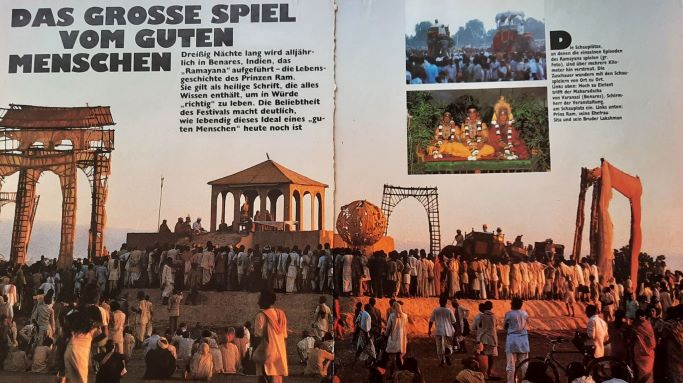
Exactly 40 years ago, I travelled to Varanasi to attend the famous Ramlila and write about it for a German magazine. It is also a chapter in my English book “Thank you India”.
Since it is again this special time of Deepavali, I post the chapter on my blog. The picture is from my German article from 1986
A journalist in the press camp of the Kumbh Mela in Haridwar in 1986 suggested writing about the colourful, grand Ramlila in Varanasi. I still enjoyed travelling and even more so if it served a purpose.
The Ramlila is a play (Leela) about Ram, the prince of Ayodhya. He lived many thousand years ago, long before Krishna. Yet even today, every Hindu child knows in detail his eventful life story, which the Ramayana depicts.
The Ramayana is one of the great epics, in which the poet Valmiki, supposedly a contemporary of Ram, vividly narrates the life story of the prince, who later becomes the king of Ayodhya. This story was narrated orally over millennia before it was written down in Sanskrit. In the 17th century, Tulsidas wrote Ramcharitmanas, the story of Ram, in the vernacular language and made it even more popular. Ram has greatly influenced the art and literature as far as in Nepal, Burma, Laos, Thailand and Indonesia. If there is one great epos for the whole of Asia, it is the Ramayana.
In India, however, the Ramayana is not just a great epos. It is a holy scripture. India without Ram would not be India. His name is everywhere. “Ram, Ram”, is a common form of greeting among Hindus in northern India. There are hundreds, if not thousands of songs extolling Ram and many people know at least some of them.
Ram is considered as an avatar – God incarnate in human form. He showed how to live a dignified life and how to conduct oneself in an ideal way in the different human relationships. Ram is an outstanding example for others – noble, just, brave, ever protecting the weak, ready rather to die than to break his word and prepared to wage war to rescue his wife Sita who had been kidnapped by a demon king.
Sita, on the other hand, possesses all the virtues, which a woman is supposed to have according to the ancient Rishis. She is modest, chaste, always intent on the well-being of her husband, warm hearted, full of trust in Bhagawan, considerate, graceful – and exquisitely beautiful. Some women’s liberation groups, which also exist in India, find fault with Sita, yet the majority of Indian women do not care. They revere Sita as their ideal even today.
For Ram to be a model for others, he has to have a difficult life. And he indeed faces countless, unexpected complications and hardship. For example, on the very day, when the handsome, much loved prince is to ascend the throne, his father Dasaratha, caused by an intrigue in the palace, has to send him into exile for 14 long years. It breaks his father’s heart. Ram calmly takes off the festive robes and dresses in the simple gown of an ascetic. Sita and his brother Lakshman insist on joining him. So the three walk out of the town into the forest – and the whole of Ayodhya weeps.
Indians do not get tired to listen to the story of Ram in ashrams or to watch it in village plays. When in the 1980s the Ramayana was shown on TV every Sunday morning over a couple of years, the streets were as empty as otherwise only during curfew or a world cup cricket match between India and Pakistan. Even the flights on Sunday morning had fewer passengers as usual.
Once I was sitting high up in the Himalaya mountains near a small temple. I could hear the crackling of loudspeakers coming from a village below. Some boys traced me. “Do people in your country also know about Ram?” they asked me. “No, they don’t know about Ram”, I replied. “How sad!” was their spontaneous reaction. Then only I realised that the crackling of the loudspeaker indicated that preparations for the Ramlila were going on in the village.
In Varanasi, the Ramlila stretches over 30 evenings in October/ November and is traditionally held under the patronage of the Maharaja. The play is staged opposite the town on the other side of the Ganga in Ramnagar and culminates on Diwali festival, when Ram returns to Ayodhya after his exile and takes over as king.
Before the play, a Pooja is performed for the actors and thereafter, they are considered true embodiments of their roles. Many spectators touched respectfully the feet of the 12-year-old boy who played Ram, when there was an occasion during breaks.
The actors were right in the midst of the crowd in some of the scenes. Nearby, a group of men dressed in white cotton cloth with yellow turbans sat in a circle on the ground and chanted the whole Tulsidas Ramayana of 24.000 shlokas. The Maharaja paid a pension to those men. In return, they had to promise to live a pure life without drinking, smoking or eating meat.
There was a festive atmosphere with plenty of food carts and stalls selling trinkets. When Ram went into exile, several thousand spectators walked with him around two kilometres to the place, where the next episode would unfold. An amazing experience in itself.
The Maharaja was present and moved high up on a fabulously decorated elephant through the crowd. His son, the prince, was sitting on another splendidly decorated elephant.
I have particularly fond memories of the journeys back across the Ganges in the middle of the night after the play. Mainly men crossed over to the town on the other side of the Ganges on countless, crowded boats in the stillness of the night – once it was even 4 o’clock in the morning. They excitedly narrated to each other how admirably Ram had conducted himself today and how exemplarily Sita had reacted –as if it just happened and they had the good fortune of being present. When the talking stopped, they started singing “Siya Ram, jay Siya Ram” – everyone in his own tune and rhythm.
Towards the end of the boat ride, while gliding past a Shiva temple on the ghats in Varanasi, they interrupted “Siya Ram” and full throatily shouted a salutation to Shiva: “Hara Hara Mahadev!”
I was not afraid of riding alone in a cycle rickshaw at that late hour from the Ganges to the tourist bungalow near the railway station through unusually empty streets. My trust was never disappointed. Varanasi is a fascinating, intense city, where life and death are present side by side, and this world and the beyond merge into each other.
Kashi (light) was the name of the city in ancient times. In all likelihood, it is the most ancient of all towns on earth and has its origin in an age, when the world was still more transparent for its luminous essence and less dense in the material sense.
Maybe the special, spiritual atmosphere of the town contributed to an amazing coincidence that happened on the side-lines: Georg, a college mate from Hamburg, had planned a trip to India. He sent a letter to my address in South India asking if we could meet. “Write to American Express in Delhi. I will be soon in Delhi” he wrote.
Yet I knew nothing of that, as I was in the North and his letter was lying in the South. Those were the times before email and mobile phone. Georg went daily to the American Express and was daily disappointed. As he could not spend his vacation waiting for a letter, he decided to go on the usual tourist route – Agra, Khajaraho and Varanasi.
One morning, as I had breakfast in the tourist bungalow, the door of the restaurant opened and in came Georg. For a while, we both stared at each other, completely stunned, unable to believe what we saw. Then we both came back to life, overjoyed at this incredible coincidence.
by Maria Wirth
link to Thank you India on Amazon.in
My latest book “Why Hindu Dharma is under attack by Muslims, Christians and the Left” is available on Amazon both in English and Hindi.
https://www.amazon.in/Hindu-Muslimon-Isaiyon-Vampanthion-Aakrman/dp/9391154832
