

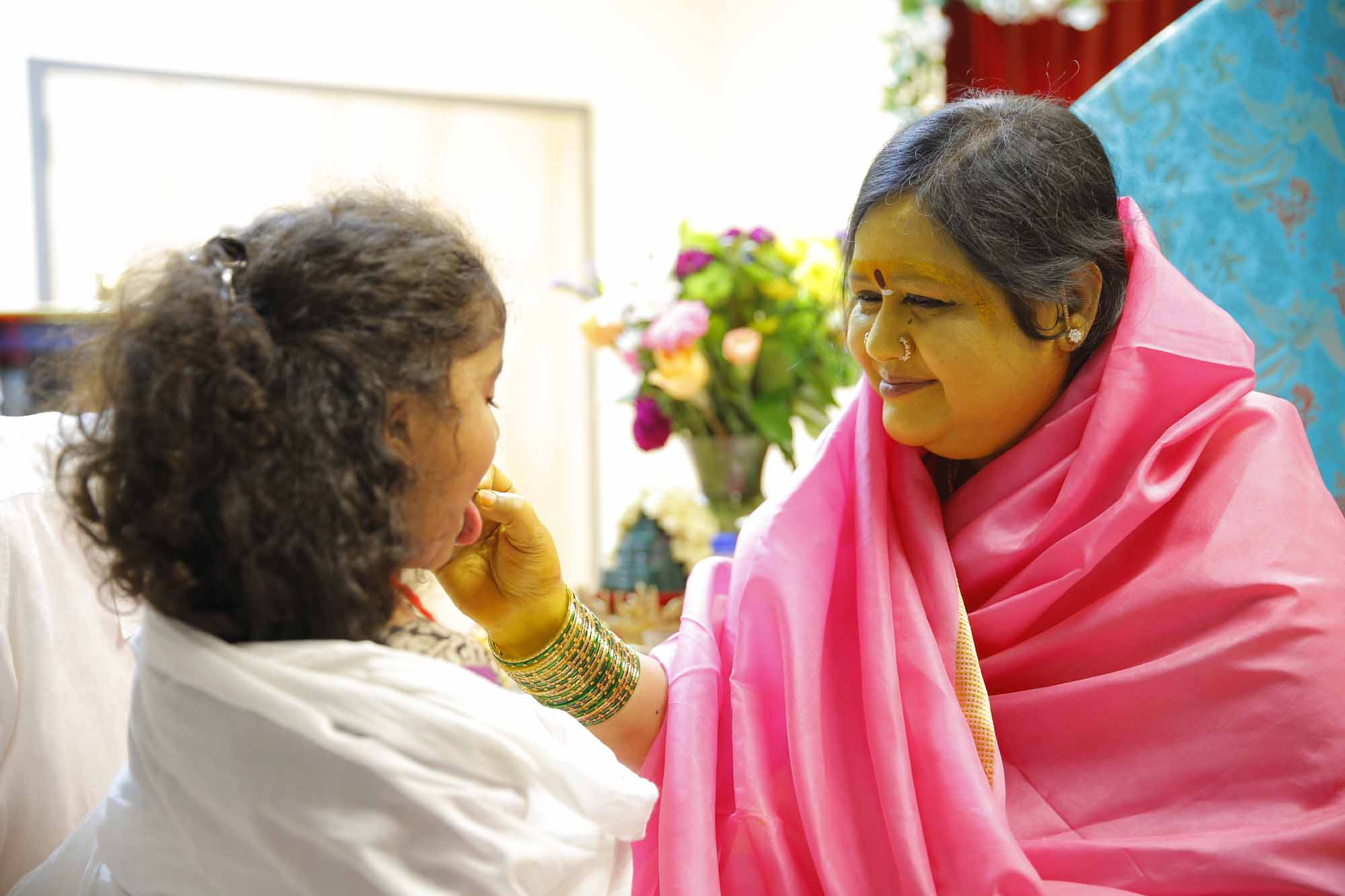
I post here another chapter from my book “Thank you India”, since it is Navaratri and Devi is worshipped. Recently I had posted about Amma or Mata Amritananandamayi. The present article is about Karunamayi or Vijayeshwari Devi. It is the 27th of 45 chapters and a bit shortened.
Karunamayi’s motherly advice:
In Bangalore, I checked into a small hotel, a colonial style villa situated right in the heart of the town. It used to be the transit point for Satya Sai Baba devotees from overseas and has meanwhile been demolished. At the reception, there was a notice regarding Vijayeshwari Devi or Karunamayi, as she is usually called. She has an ashram in Andhra Pradesh and also tours the West. The notice read that, at present, she was staying in Bengaluru and on Diwali evening, there would be a celebration at the given address.
As I had nothing else to do, did not feel particularly great and did not want to sit in my room on that great festive night, I started off in an auto rickshaw in the late afternoon. It took one hour to get through the city. The traffic near the city market was chaotic, and I admired the people there who quite cheerfully carried on with their chores in small stores and workshops on the roadside – in the midst of deafening noise and extreme pollution from exhaust fumes.
Karunamayi had a hall at her disposal on the first floor of a building in a quiet residential area. It slowly filled with visitors, while preparations were still underway. People sat in small groups on the floor and threaded flower garlands. Others pulled petals from flowers, which were lying all over in big heaps. The whole room was filled with fragrance and with soothing, devotional music. At the entrance, there was a table with books and cassettes for sale. The atmosphere was welcoming. There were about hundred people, in contrast to the thousands at Sai Baba’s ashram. Some nodded encouragingly and smiled at me. I was the only foreigner. As I did not feel like pulling flower petals, I sat down on the floor and waited.
To mark the occasion the thousand names of Lalita, the divine mother, were recited and with each name a handful of flower petals were offered, which slowly grew into a big heap. Karunamayi sat down on the floor in front, facing us. She looked motherly with her 35 years at that time. There was no special fanfare, when she entered. After she sat down, she gave me a long, compassionate glance and tears fell on my yellow silk kurta, and made big, dark stains.
My life suddenly seemed so wasted. I was now in my early forties and had neither achieved success in the worldly nor in the spiritual sense. I neither enjoyed the love and security of a family, nor had I found love and security in God. All of a sudden, I felt very alone. Everyone around me seemed to belong somewhere. Without doubt, nobody had come to the celebration alone – except me.
The glance of Karunamayi made me cry. I had always asked God, whom I mainly called Shiva or Bhagawan, not to lead me on a wrong path. Had he taken me for a ride? Had the seven years with Sai Baba been in vain, thrown away? Had I become more tense and inhibited due to the many rules in the ashram instead of becoming freer and wider? I did not know and felt no ground under my feet.
At the end of the function, Karunamayi put Kumkum on everyone’s forehead. When it was my turn, Karunamayi said, “Come again”. I was glad, because it gave me at least something to do. I bought a booklet about her life at the entrance. Her cousin, who looked after the sales, suggested I should talk to Karunamayi tomorrow morning in private.
The next morning, I went again to Karunamayi. At her place, it was quiet. Her cousin at the book table ignored me. Maybe he felt embarrassed that he had given me hope for a private talk today. As I soon came to know, Karunamayi would remain in prayer and meditation for the whole day and not meet anybody. Instead, I met her mother. She looked straight and calmly at me for quite a while, as it happens often in India, before she asked in Telugu, where I came from. I did not know who this old, small woman was, till someone introduced her.
I had already read about Annapurnamba, her mother. She got married as a child of eight. At 17, when she was already the mother of two daughters, she paid a visit to Ramana Maharshi in Tiruvannamalai.
“Do you like to live in an ashram?” he asked her.
“Your grace, Bhagavan”, she answered reverentially.
“Not now and not in this ashram. You will live in the ashram of your daughter, and you need not go anywhere else. Everyone will come to you. You will give birth to the divine mother”, Ramana Maharshi told her.
Annapurnamba was too shy to ask the great Ramana for clarification on what he had said.
In 1958 on Vijaya Dasara, Annapurnamba gave birth to her fourth child. It was a girl and she was called Vijayeshwari.
About the young Vijayeshwari, too, miraculous stories were told, not quite as spectacular, as those about the young Satya Sai Baba, but spectacular enough to make people take notice of her.
Once, for example a family friend was visiting. Her son had left his home ten years ago and since then had never given any sign of life. Naturally, his mother suffered from this loss, and when she was visiting that day—it was the 14th June 1968—she started crying. Vijayeshwari, who was sitting over her homework in a corner, came over to her, caressed her cheek and comforted her, “Your son will come back to you day after tomorrow.” “If this is true, I will worship you as a goddess”, the woman reacted and, in all likelihood, did not believe that Vijayeshwari could be saying the truth.
On 16th June, in the morning around 6 o’clock, when the mother was just saying her prayers, her son came walking through the door. She promptly took him to the house of her friends and fell at the feet of the 10-year-old girl, whose mother protested against her doing so.
Vijayeshwari’s father had her horoscope made. It said that Vijayeshwari was a divine person, would spread wisdom and give refuge to the poor and deprived. She would not marry, but settle in the forest.
Her father was horrified to imagine his daughter living alone in the forest with all its inherent dangers. Vijayeshwari just came back from school, when he was brooding over the horoscope, and addressed him,
“Father, why are you so depressed about a small thing?”
“Which small thing?” the father wanted to know.
“Because of my life. That I will live in the forest for some time.”
The father was more than amazed. His little daughter could not know anything about the horoscope.
Her father died when she was eight and did not live to see, that for 12 years – from 1980 to 1992 – she meditated deep in the forest often for days without food, and that indeed she became the refuge for the poor and deprived by founding orphanages and schools.
Some days later, I had a private talk with Karunamayi.
She stood in a room, which was empty except for a small shrine in a corner, and waited for me with a fountain pen in her hand. “You are a daughter of Saraswati”, she said and gave me the pen. Saraswati is the goddess of wisdom and learning. I was happy about the unexpected gift, and we both sat down on the stone floor. I told her that I had spent several years with Satya Sai Baba, and now did not know what to think of him. I probably talked too fast and was not sure whether she could follow me.
“What about the faith in a guru? Is it necessary?” I finally asked.
“Try to have the same faith as before”, she answered.
“It is not possible anymore”, I said.
She seemed satisfied with my remark.
“The reason is, because you want the highest”, she said. “You are in truth Atman, infinite. You are the one Self. I want all human beings to realise their Self. Meditation is necessary for it. Your Self is like thousand suns. Everything is in you. Atman is in-visible, that means”, she explained, “He is in you visible during meditation.”
She only briefly mentioned the ashram of Sai Baba and did not make any comment about him. “In Satya Sai Baba’s ashram meditation is not given a proper place. That is the reason why there is so much competition. You must meditate and go inside”, she urged me and promised, “I will help you. It is my responsibility.”
At the end, she asked me to walk around her three times and do pranam. After I had finished and stood in front of her, she handed me a 5 cm high statue of Saraswati Devi. The metal was vibrating hot, yet not in a manner, that one would get burnt. Later, I sometimes tried rubbing the statue between my hands or keeping it on my body, but did not succeed in generating that type of heat.
Was Karunamayi hinting that the miracles of Satya Sai Baba are not so special, that materialisations or transportations are possible for her, as well, and not worthwhile talking about? During materialisations and transportations, heat is supposedly generated. I had a hunch that the statue had not reached her hands in a normal way, yet I did not ask her about it, because at that moment, it felt not worthwhile talking about. Only later, certain curiosity cropped up.
While I was taking leave, she said again, “You are a daughter of Saraswati. Write about the Divine.” When I was almost at the door, she added, “Consider my ashram as your home. You are always welcome.”
It felt good to hear this, because I did not have a home. My gas stove and refrigerator were still in Prasanthi Nilayam and I had no idea, to which place I would transport my belongings. Not to an ashram, so much was clear. But I was grateful that she made me feel welcome. In the night after the meeting, I had a dream: I lit candles and knew that it was New Year.
I took Karunamayi’s advice to meditate to heart. I noticed then only how much I had neglected meditation during the years in the ashram. Sai Baba once said that meditation was useless, since we would only sit and think about all kinds of things. Instead, we should rather serve our fellow human beings. I felt he had a point. Yet maybe mediation is not useless, even if thoughts dominate.
Now I sat down regularly for one hour in the morning and evening and sometimes also in the silent night, if I happened to wake up. The meditation kept me going at that time, when I rather wanted to be dead than alive. I had lost my home, my friends and whatever structures my daily life had had, and sometimes felt as if I was floating in mid-air – without any support.
Karunamayi had recommended a simple, but in the Indian tradition basic breathing exercise, called Anulom-Vilom, which I practised before meditation. She placed great importance on this pranayama and had given me a list of all its benefits. The list was long.
Still, my meditation was not conforming to my idea of a ‘good’ meditation. Again and again, thoughts took me on excursions and only occasionally some peace was felt. However, now there were often beautiful experiences in the morning in between the state of sleeping and being fully awake.
It had happened earlier, too, that in this state all my cells were vibrating with bliss. Once I saw Shiva before me, with a peaceful countenance and long hair, as he is pictured on posters. Brilliant light shot out from his third eye on his forehead and entered my third eye and I heard “Om namah Shivay”. I felt ecstatic. Each cell in my body was in jubilation. I was lying on a berth in a train with over 80 people in the second-class compartment and possibly could not have stood more bliss. Such wonderful feelings came now more frequently. They came as a surprise gift and helped me to become gradually certain that there is truly something great and loving alive inside me.
When Karunamayi went back to her ashram in Andhra Pradesh some 200 km north of Chennai, I did not join her. It took me fourteen years until, in January 2008, I visited her ashram at the foot of the steep Garudadri hills and close to the temple of Sri Narasimha Swami. The place is literally at the end of the road.
After reaching, I sat quietly in the spacious temple dedicated to Sri Lalita, when a woman called me. I thought she wanted to see my passport and followed her – and ended up in a small room where Karunamayi was sitting on a couch. It felt as if no time had passed since last seeing her. Her eyes narrowed to sparkling, black slits – so big was her smile.
“Those hills are special. The seven Rishis have meditated here, and the place is as holy as Arunachala Mountain in Tamil Nadu”, she said in a soft voice, smiling. She knows those hills in and out. It was in those hills where she had meditated for 12 years.
In her ashram, a weeklong meditation retreat had just ended and only a few Russians and Americans were left over from it. The spacious ashram looked empty, but the priests performed their daily routine of worshipping the main deity of the temple. They chanted the Vedas for several hours, performed homa, and recited Lalita Sahasranama every day.
A few days after my arrival, however, the ashram was teeming with people and wore a festive look. It was a Saraswati Pooja and Karunamayi gave initiation into the Saraswati Mantra to students. Thousands had come. Right from the ashram gate up to the temple visitors lined up, proceeding slowly. They filed past her from 7 in the morning till 7 in the evening. Karunamayi dipped a small Tulsi twig in honey and wrote a mantra on the tongue of the student, while the parents stood by.
On my last day in the ashram, a big group of village folk filled the temple in the evening. It was obvious that they had never seen a foreigner and some of the children, after discovering me, pointed excitedly or shyly towards me. Karunamayi sat among the villagers who were crowding around her. “Sri Lalita is in the form of consciousness”, was one of the few sentences I understood during her talk in Telugu.
It struck me that only in India such highly philosophical statement can be made even to villagers. In the West, in contrast, even educated people might have a blank stare on being told that God is in the form of consciousness. There, hardly anyone wonders what the basis for this world is and here, in the deep interior of India, simple villagers are taught the highest wisdom. Karunamayi then initiated us into the Sri Chakra mantra. She kept chanting it and we all repeated it, till the last person got the pronunciation right.
Suddenly she talked in English. I was the only foreigner and she addressed me directly. “Layers of karma will be burnt up by meditation”, she said and “The mantra has to be given by a guru to be effective in the right way.” She exhorted me, “Go inside with the right insight. You are Atmaswarup.” And in the end a comforting assurance: “Wherever you go, wherever you are, I am with you.”
I was leaving the next morning. She did not come with me, or did she? “The physical body which you see is not real”, she had earlier explained. “I am not this limited body. I am the auspicious, divine Light and not the bodily, material form. On the ordinary level of consciousness, you see Amma and yourself as different. Yet if you go above that, you will see yourself and Amma as one. There is no difference between the Atmas.”
It was the same message that all Indian sages give: that, what she essentially is, is definitely always with me. It has to be, as it is my essence, too, and the essence of everyone.
By Maria Wirth
link to Thank you India on Amazon.in
My latest book “Why Hindu Dharma is under attack by Muslims, Christians and the Left” is available on Amazon both in English and Hindi.
https://www.amazon.in/Hindu-Muslimon-Isaiyon-Vampanthion-Aakrman/dp/9391154832
